Here’s what was decided.
A major controversy has erupted in Ohio’s closely watched governor’s race after Republican candidate Vivek Ramaswamy, a prominent ally of President Donald Trump, stopped airing a controversial political advertisement targeting his Democratic opponent, Amy Acton.
The decision comes just days before the November 3 midterm elections, as new polling raises concerns about whether the advertisement damaged Ramaswamy’s chances of winning.
Although Ramaswamy maintains that the commercial simply completed its scheduled run, the decision follows widespread criticism from political leaders in both parties.
The controversy has also exposed disagreements among Republicans over campaign strategy, with Trump and Vice President JD Vance defending Ramaswamy while other prominent GOP figures questioned his approach.
With control of the Ohio governor’s office at stake, the developments could have important consequences during the final days of the election.
Ramaswamy Ends Controversial Campaign Advertisement
Ramaswamy’s campaign has stopped broadcasting an advertisement featuring Donna Arthur, the estranged mother of Democratic gubernatorial nominee Amy Acton.
The commercial featured Arthur criticizing her daughter’s honesty and questioning whether Ohio voters should trust her to lead the state.
However, the advertisement quickly attracted criticism because of the family’s deeply troubled history.
Acton has publicly discussed experiencing abuse during childhood and has said her mother failed to protect her.
Her stepfather was subsequently indicted, and Acton and her brother were removed from their mother’s custody in 1978.
Acton has said she has not maintained contact with her mother since that time.
Her campaign condemned the commercial, arguing that Ramaswamy was using a painful family experience to gain a political advantage.
The dispute soon became one of the most widely discussed developments in the Ohio governor’s race.
Republican Poll Reveals Troubling Numbers
The advertising controversy intensified after a Republican-commissioned poll suggested that Acton was gaining ground against Ramaswamy.
According to polling obtained by Axios, Acton’s advantage increased from two percentage points earlier in October to eight points after the advertisement began circulating.
The earlier survey showed Acton leading 47% to 45%.
The subsequent survey, conducted October 23 through October 26, produced a noticeably different result:
- Amy Acton: 50%
- Vivek Ramaswamy: 42%
- Reported Democratic advantage: 8 percentage points
The survey included 800 likely Ohio voters and carried a margin of error of approximately 3.5 percentage points.
Perhaps more concerning for Republicans, 86% of respondents indicated they were familiar with the advertisement.
Among respondents who knew about the commercial, those saying it made them more likely to support Acton outnumbered those who said it helped Ramaswamy by roughly two to one.
These findings raised questions about whether the political attack had generated an unintended backlash.
However, the results do not prove that the advertisement caused the change in voter preferences.
A separate Suffolk University poll showed a narrower advantage for Acton, suggesting that the race remains uncertain.
Trump And Vance Stand Behind Republican Candidate
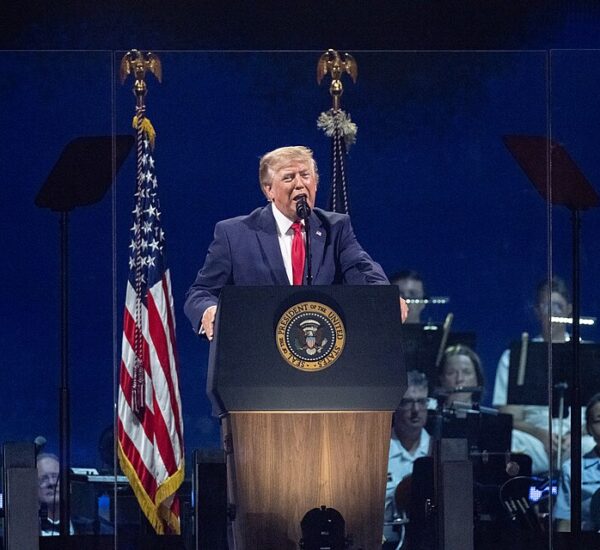
Despite criticism surrounding the commercial, President Trump publicly defended Ramaswamy’s decision to air it.
Trump argued that the Republican candidate was being treated unfairly and maintained that examining a political opponent’s credibility is a legitimate part of an election campaign.
Vice President JD Vance also supported Ramaswamy, pushing back against Republicans and Democrats who criticized the advertisement.
Their defense demonstrated the strong political support Ramaswamy continues to receive from two of the Republican Party’s most influential leaders.
However, not every Republican agreed with the campaign’s approach.
Ohio Governor Mike DeWine publicly opposed the advertisement and urged Ramaswamy to stop broadcasting it.
Republican Senator Jon Husted also indicated that he would not have chosen to run the commercial.
The disagreements illustrate a broader challenge facing Republican candidates as they attempt to balance aggressive campaigning with the need to attract undecided voters.
Campaign Spending Raises Additional Questions
Another notable development involves the amount of money Ramaswamy’s campaign ultimately spent promoting the controversial advertisement.
The campaign initially announced plans to invest approximately $4 million in statewide advertising.
However, figures from political advertising tracker AdImpact indicated that only about $1 million was spent before the commercial stopped airing.
That represents approximately 25% of the originally announced investment.
The difference has prompted questions about whether campaign officials reconsidered their advertising strategy as criticism intensified.
Speaking during a campaign appearance in Vandalia, Ohio, Ramaswamy said the advertisement had completed its intended run.
He also explained that his campaign had moved on to other commercials.
His campaign has not confirmed that the decision was connected to the reported polling results.
Nevertheless, the timing has attracted attention among political observers following the competitive gubernatorial contest.
Why Ohio’s Governor Race Matters
The Ohio governor’s race has become an important political contest as Republicans seek to maintain their influence in a state that has supported Trump in recent presidential elections.
Ramaswamy gained national recognition during the 2024 Republican presidential primary before becoming a prominent supporter of the president.
His campaign for governor has emphasized economic development, government efficiency, education policy, and reducing regulations on businesses.
Acton, a physician and former director of the Ohio Department of Health, has concentrated on healthcare, education, and economic issues affecting families across the state.
Their competing priorities have created a significant choice for Ohio voters.
Republicans hope to maintain control of the governor’s office and continue advancing policies focused on economic growth and limiting government interference.
Democrats view the contest as an opportunity to regain influence in statewide politics.
The advertising dispute has added another layer of uncertainty to an already competitive election.
Republicans Face Important Final Campaign Test
Beyond the governor’s race, some Republican strategists have expressed concern that the controversy could affect other GOP candidates appearing on Ohio ballots.
Senator Jon Husted, who is seeking reelection, is among those whose campaigns could be affected by broader voter dissatisfaction.
With control of Congress also at stake in the midterm elections, Republicans have strong incentives to maintain voter enthusiasm and avoid unnecessary political distractions.
For Ramaswamy, the immediate challenge is shifting attention back toward the issues his campaign believes will resonate with Ohio residents.
Those include job creation, economic opportunity, government spending, education, and the state’s long-term economic future.
Many voters will also be weighing the candidates’ leadership experience and their ability to deliver on campaign promises.
Whether the Republican candidate can regain momentum before Election Day remains uncertain.
Election Day Approaches As Questions Remain
With November 3 approaching, both campaigns are entering the final stretch of a closely watched contest.
Ramaswamy continues to enjoy support from President Trump and Vice President Vance, two influential figures whose endorsements could help energize Republican voters.
However, the controversy surrounding his discontinued advertisement shows how quickly campaign messaging can become a political liability.
The latest polling has given Democrats reasons for optimism, but surveys cannot determine the final election outcome.
Ultimately, turnout, undecided voters, and the effectiveness of each campaign’s closing message will help determine who becomes Ohio’s next governor.
For Republicans, the central question is whether Ramaswamy can move past the controversy, rebuild momentum, and secure a victory in a state that has become an important part of the GOP’s national political coalition.
Ohio voters will have the final say on November 3.