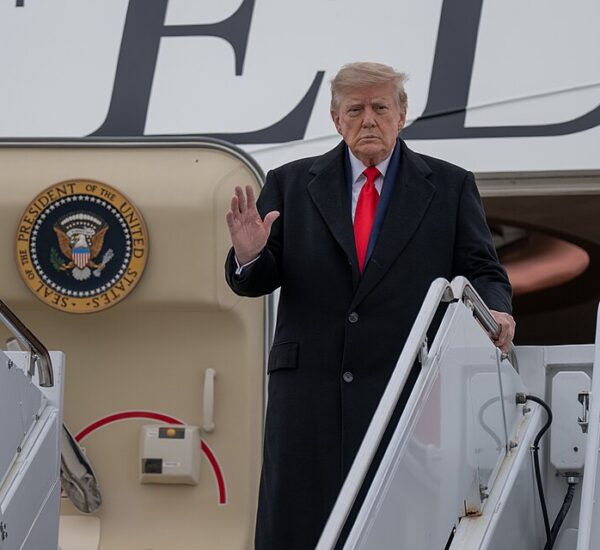
Trump is cracking down.
President Donald Trump is once again taking on one of America’s biggest television networks, this time after NBC News anchor Kristen Welker questioned the strength of his endorsement record in Republican primary elections.
Trump fired back Sunday after Welker, moderator of NBC’s “Meet the Press,” described the president as having achieved “mixed results” with his endorsements during the current election cycle.
The president strongly disputed that characterization.
Trump pointed to his overwhelming winning percentage in Republican primaries and argued that NBC’s description failed to accurately reflect his political influence among GOP voters.
The disagreement quickly became about much more than election statistics.
Trump announced that he planned to report the matter to the Federal Communications Commission and called on FCC Chairman Brendan Carr to take concerns about political coverage on public airwaves seriously.
For millions of Americans who have grown skeptical of the mainstream media, the confrontation raises a familiar question: Where is the line between legitimate political commentary and misleading coverage?
Trump Challenges NBC’s Description
Trump argued that the numbers tell a much different story from the one presented by Welker.
According to figures cited by Ballotpedia, Trump has made approximately 313 endorsements and recorded a success rate of roughly 96%.
That doesn’t mean every Trump-backed candidate has won.
Some of the president’s endorsements involved candidates who were already heavily favored, while several Trump-supported Republicans suffered significant primary defeats.
Nevertheless, a 96% overall winning percentage gives Trump considerable ammunition to challenge the idea that his endorsement results have simply been “mixed.”
Trump emphasized his congressional record in particular, saying candidates carrying his endorsement won 100% of Republican Senate primaries and approximately 98% of GOP House primaries.
The president also argued that some candidates were given little chance of victory before receiving his support.
Trump’s Endorsement Still Carries Weight
Trump’s influence over Republican primary voters has been one of the defining features of modern GOP politics.
An endorsement from a sitting president can generate national attention for a candidate, energize grassroots supporters and potentially attract additional campaign contributions.
Trump pointed to competitive Republican races as evidence that his support remains consequential.
He highlighted recent victories in South Carolina and Oklahoma while arguing that his endorsement has become one of the most powerful forces in American electoral politics.
There have been exceptions.
Trump-backed candidates suffered losses in several states, including Florida, Michigan, Tennessee, Iowa, Georgia and Minnesota.
Those defeats have given Trump’s political opponents and media critics material for questioning whether his influence has weakened.
But Trump maintains that concentrating on individual losses while overlooking his overall record paints an incomplete picture.
NBC Defends Kristen Welker
NBC News stood behind Welker following the president’s criticism.
A network spokesperson told the New York Post that NBC considers Welker one of the best journalists in the business and supports her.
Trump clearly sees the situation differently.
The president accused left-leaning news organizations of attempting to minimize his political victories while placing greater emphasis on Republican candidates who lose despite receiving his endorsement.
It is part of a much larger battle between Trump and traditional media organizations that has stretched across his political career.
Trump has repeatedly accused major networks of treating Republicans and conservatives differently from Democrats, while his media critics argue that aggressive coverage of a president is a normal and necessary function of journalism.
Why Trump Mentioned the FCC
Trump’s decision to involve the FCC adds another layer to the controversy.
Broadcast television stations operate differently from cable networks. The federal government licenses individual broadcast stations because the public airwave spectrum available for television and radio transmissions is limited.
That distinction has become increasingly important as Trump and his allies push for greater accountability from major broadcasters.
FCC Chairman Brendan Carr has previously signaled a willingness to scrutinize broadcasters and their responsibilities.
However, government involvement in disputes over political journalism also raises important First Amendment concerns.
Supporters of tougher accountability argue that broadcasters benefiting from access to public airwaves should maintain high standards of accuracy and fairness.
Critics counter that government regulators should not punish news organizations simply because elected officials object to their coverage.
That debate is unlikely to disappear anytime soon.
Trump’s Media Battle Continues
Trump’s criticism of Welker comes amid his broader confrontation with some of America’s largest media companies.
His administration has previously clashed with ABC News, and Trump has personally challenged television personalities over statements about his political record.
Comedian Bill Maher previously drew Trump’s attention after questioning the effectiveness of the president’s endorsements.
Maher later acknowledged on television that Trump’s endorsement record was stronger than his earlier comments had suggested.
Now Trump wants similar attention paid to NBC’s characterization.
The Numbers Behind Trump’s Argument
The most important question for voters may ultimately be whether Trump’s endorsement remains capable of changing Republican primary elections.
His overall winning percentage suggests his backing remains highly valuable, although raw percentages don’t tell the entire story.
Endorsing a heavily favored incumbent is considerably different from helping an unknown candidate defeat an established Republican.
That’s why Trump’s performance in genuinely competitive races could provide a better measurement of his political strength than the overall percentage alone.
Still, winning approximately 96% of endorsed races is a statistic that is difficult to ignore.
Trump believes the media isn’t giving that record the credit it deserves.
His critics believe the losses deserve attention as well.
Media Trust Remains a Major Issue
The confrontation also arrives at a time when trust in traditional institutions continues to be an important political issue.
For older Americans who grew up when the three major television networks dominated national news coverage, today’s fragmented media environment looks dramatically different.
Americans now receive political information from cable television, podcasts, social media, independent websites, streaming platforms and traditional broadcasters.
That means disputes over accuracy can quickly become national political stories themselves.
Trump has successfully turned criticism of the mainstream media into a central part of his political identity, frequently appealing directly to supporters rather than relying on traditional news organizations to communicate his message.
His latest confrontation with NBC demonstrates that strategy remains very much alive.
Trump Isn’t Backing Down
Whatever Americans think about Trump or NBC News, the underlying numbers will continue to be examined as Republican primary season moves forward.
Trump has suffered several noteworthy endorsement defeats.
But he has also accumulated substantially more victories.
The president believes that record proves his endorsement remains extraordinarily influential inside the Republican Party.
Welker’s description clearly struck a nerve, and Trump responded by putting NBC, the FCC and the broader debate over political media coverage back in the national spotlight.
With major elections approaching, Trump’s ability to influence Republican voters will continue to be tested.
And if his winning percentage remains anywhere close to its current level, arguments over the true power of a Trump endorsement aren’t likely to end anytime soon.