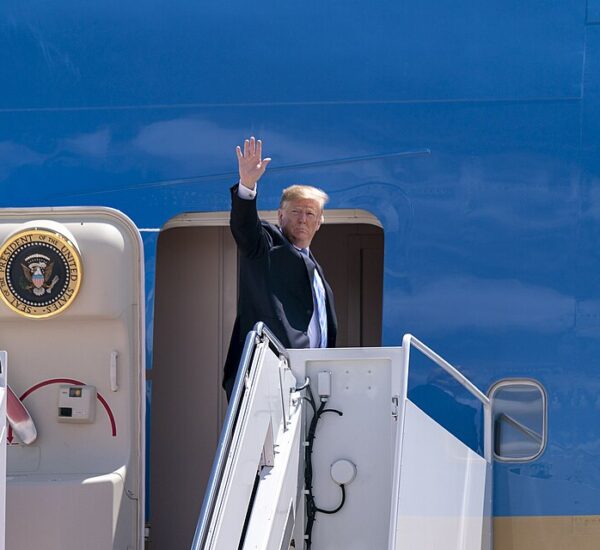
Trump has something to look forward to.
Republicans have received encouraging news ahead of the 2026 midterm elections, as a new national poll suggests the race for control of the House of Representatives is becoming far more competitive than many political analysts expected.
A newly released Washington Post-Ipsos survey shows Democrats holding a narrow 48% to 45% advantage among registered voters on the generic congressional ballot—a smaller lead than earlier this year and one that has Republicans believing the political landscape may be shifting.
The latest numbers represent an improvement for the GOP compared to May, when Democrats held a 49% to 44% edge in an ABC News/Washington Post-Ipsos poll.
While Democrats still maintain the advantage, Republicans have clearly gained ground.
The tighter race is especially notable because Democrats entered previous midterm elections with much larger polling leads. Before the 2018 “blue wave,” Democrats enjoyed roughly a 10-point advantage before ultimately winning control of the House.
That history makes the current polling far more encouraging for Republicans than many expected.
Even prominent Democrats are warning their party not to assume victory.
Neera Tanden, president and CEO of the Center for American Progress, reacted to the new survey by cautioning fellow Democrats against expecting a landslide.
“Everyone assuming a landslide in November should just probably rethink that,” Tanden wrote on X.
Republicans also have another advantage heading into the fall campaign: money.
The GOP’s campaign committees have built sizeable fundraising war chests, giving Republican candidates additional resources to compete in key battleground districts across the country.
Meanwhile, Democrats continue to struggle with divisions inside their own party following President Donald Trump’s victory in the 2024 presidential election.
Moderate Democrats and the party’s progressive wing remain at odds over policy priorities, messaging, and the future direction of the party. Those internal battles have complicated Democrats’ efforts to present a unified message to voters.
The poll also delivered encouraging news for Republicans on several of the issues Americans care about most.
Registered voters said Republicans better represent their interests by a 41% to 40% margin.
On the economy—consistently one of the top concerns for voters—Republicans also held an advantage, with 39% saying the GOP would do a better job, compared to 35% for Democrats.
Those numbers could become increasingly important as inflation, household costs, and economic growth remain major campaign issues heading into Election Day.
Despite the improved outlook for Republicans, Democrats still maintain important strengths.
Among voters who say they are certain to cast ballots this November, Democrats hold a 10-point advantage, a level of enthusiasm similar to what they enjoyed before their successful 2018 midterm campaign.
Republicans have also acknowledged concerns about turnout now that President Trump will not appear on the ballot. Party leaders are working to energize conservative voters while navigating disagreements within the GOP over foreign policy and other major issues.
Political analysts continue to view Democrats as slight favorites to regain the House. However, the shrinking polling gap suggests the battle may be much closer than many expected just a few months ago.
The latest RealClearPolitics polling average also shows Democrats leading the generic congressional ballot by approximately 4.7 percentage points, reinforcing that the race remains competitive rather than one-sided.
The Washington Post-Ipsos survey interviewed 2,092 registered voters between July 8 and July 13 and reported a margin of error of plus or minus 2.2 percentage points.