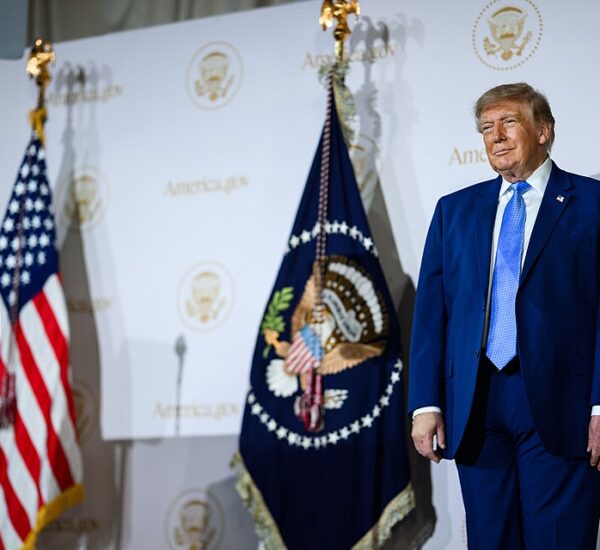
House Republicans hit another roadblock Tuesday after 14 GOP lawmakers voted against a procedural rule needed to advance the National Defense Authorization Act, arguing the defense bill should include the SAVE Act, President Donald Trump’s voter ID proposal. The failed vote stalled action on the military funding measure and exposed renewed divisions within the Republican conference over how to move Trump’s election legislation forward.
BACKGROUND
The House has already passed the SAVE Act three times, but the measure has not secured enough support to pass the Republican-controlled Senate. According to Axios, disputes over the SAVE Act have repeatedly disrupted House business by delaying procedural votes and unrelated legislation. Following Tuesday’s vote, Rep. Max Miller accused Speaker Mike Johnson of breaking his word about allowing a path to attach the SAVE Act to the defense bill, saying Johnson “lies more than anyone I’ve ever met.” With the procedural vote defeated, the path to advancing both the defense bill and other legislation before the July 4 recess remains uncertain.
A Deeper Look At Trump’s Iran Strategy
President Donald Trump is keeping military options available against Iran but is choosing, for now, to continue pursuing a diplomatic solution rather than launching another large-scale military campaign.
According to a report from The Wall Street Journal, Trump has recently held multiple strategy sessions with Hegseth and Dan Caine, chairman of the Joint Chiefs of Staff, to evaluate America’s next move as negotiations with Tehran continue.
Officials familiar with the discussions said military leaders have presented plans that could quickly resume major airstrikes if diplomacy collapses. Some inside the administration reportedly described the option as “finishing the job.”
Trump Prioritizes Diplomacy—For Now
Despite keeping military force on the table, Trump has reportedly told advisers he believes launching another full-scale offensive at this stage could undermine ongoing negotiations and make it more difficult to permanently eliminate Iran’s nuclear ambitions.
Two weeks ago, the United States and Iran signed a memorandum of understanding (MOU) that halted weeks of hostilities following joint U.S.-Israeli strikes targeting Iran’s military infrastructure and senior leadership.
The temporary agreement created a 60-day framework for negotiations aimed at reaching a broader and more permanent settlement.
As part of the arrangement, Iran agreed to work toward ensuring the safe passage of commercial shipping through the Strait of Hormuz. In exchange, the United States agreed to lift its naval blockade of Iranian ports while negotiations continue.
Trump Open to Extending Nuclear Deadline
Officials told the Journal that Trump is also willing to allow talks to continue beyond the current Aug. 18 deadline if negotiators believe meaningful progress is being made.
The extension would provide both sides additional time to reach an agreement without immediately returning to open conflict.
At the same time, Trump has reportedly approved limited military responses whenever Iran violates the agreement rather than ordering a broader campaign.
That approach was tested last weekend after an Iranian drone reportedly struck a commercial vessel in the Strait of Hormuz, triggering a series of retaliatory exchanges between both sides.
JD Vance: America Still Has Plenty of Options
Vice President JD Vance reinforced the administration’s position during an appearance on Fox News Tuesday.
Vance said President Trump wants to determine whether diplomacy can succeed before considering more aggressive military action.
He added that if negotiations fail, the United States still has numerous options available while maintaining that recent military operations have already strengthened America’s position.
Vance also revealed during an interview with the British publication UnHerd that Washington and Tehran have established a military deconfliction channel in Doha, Qatar. The communication line includes representatives from U.S. Central Command (CENTCOM) and Iran’s Islamic Revolutionary Guard Corps (IRGC) to reduce the risk of unintended escalation.
Negotiations Continue Despite Major Disagreements
Trump continues to receive regular military briefings from Pentagon leaders as his administration weighs both diplomatic and military strategies toward Iran.
Officials told the Journal that the latest discussions indicate Trump is seeking a breakthrough while remaining prepared to act if negotiations stall.
Privately, some administration officials acknowledge that resuming a major military campaign would signal that the current diplomatic framework has failed.
Special envoy Steve Witkoff and White House adviser Jared Kushner arrived in Doha this week for another round of indirect negotiations. Qatari officials said American and Iranian representatives are communicating through mediators rather than meeting face-to-face.
Technical experts from both countries are also expected to continue indirect discussions.
Strait of Hormuz Remains a Sticking Point
One of the biggest obstacles remains Iran’s demand to collect billions of dollars in fees from commercial ships passing through the Strait of Hormuz.
The Trump administration has rejected that proposal, insisting international shipping must remain free to navigate one of the world’s most important energy corridors without interference.
Another major disagreement centers on Iran’s nuclear program.
While President Trump has publicly stated that Tehran has agreed to significant nuclear limitations, Iranian officials continue insisting they will not accept sweeping restrictions on their program.
Military Pressure Still Available
Some analysts point to the newly established communication channel between CENTCOM and the IRGC as evidence that tensions have eased somewhat.
Others caution that the arrangement remains fragile and could quickly unravel if negotiations break down.
As uncertainty continues, Pentagon leaders have reportedly presented President Trump with updated military plans that would allow the United States to rapidly resume large-scale air operations against Iranian military targets if necessary.
Foreign policy experts say Trump also possesses powerful economic tools that could increase pressure without immediately returning to war.
Those options include delaying Iran’s access to billions of dollars in frozen assets and increasing economic costs associated with any attempt by Tehran to disrupt shipping through the Strait of Hormuz.
Analysts say this strategy allows the administration to maintain maximum leverage while leaving the door open for diplomacy.
For now, President Trump appears determined to pursue peace from a position of strength—keeping America’s military prepared while giving negotiations one more opportunity to produce a lasting agreement.