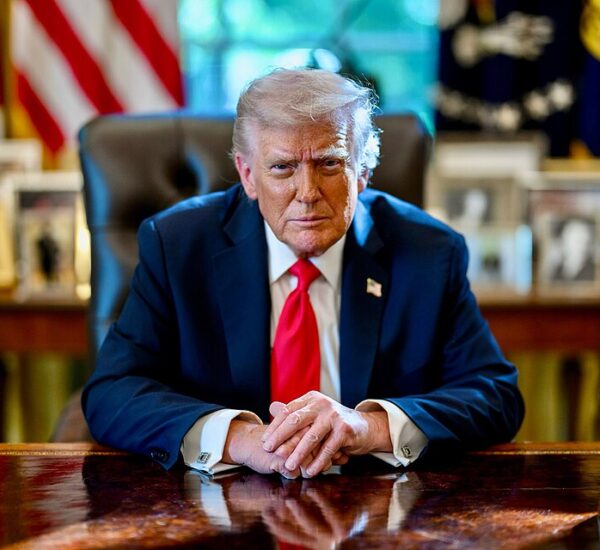
Trump made a surprisingly candid confession.
President Donald Trump has offered a revealing look at the future of his Make America Great Again movement, addressing whether MAGA can survive without him and who might eventually take control of the Republican Party.
Speaking during a wide-ranging interview with CBS News’ 60 Minutes, Trump expressed confidence that the movement he built could continue long after his presidency ends.
However, the president also delivered an unexpected answer when asked whether he plans to endorse a Republican successor in the 2028 presidential election.
His comments arrive at a particularly important moment for Republicans, who are attempting to regroup following major defeats in the 2026 midterm elections.
With Democrats preparing to take control of both chambers of Congress, questions about the Republican Party’s leadership and political future are becoming increasingly difficult to ignore.
Trump Makes His Position On MAGA’s Future Clear
During the November 8 interview, CBS correspondent Ross Douthat asked Trump whether the Make America Great Again movement could continue without him leading it.
The president responded that he believes it can, arguing that MAGA represents a broader political philosophy rather than simply one individual.
Trump described the movement as being rooted in common-sense principles, particularly when it comes to border security, military strength and economic prosperity.
He also pointed to what he considers the economic achievements of his administration.
The president’s remarks suggest he believes the movement has developed an identity strong enough to remain influential even after another Republican takes the national spotlight.
That confidence is significant considering how closely MAGA has been associated with Trump’s political career since his first presidential campaign in 2016.
Over the past decade, Trump has helped reshape Republican priorities and build a political coalition that places considerable emphasis on immigration enforcement, domestic manufacturing, trade policy and American national interests.
Whether that coalition can remain united without Trump as its central figure is now one of the biggest questions facing the GOP.
Trump Discusses Who Could Replace Him In 2028
The conversation also turned toward the next presidential election and the Republican leaders who might compete for the party’s nomination.
Vice President JD Vance and Secretary of State Marco Rubio are among the prominent names being discussed as possible successors.
When asked about Rubio, Trump praised his performance as secretary of state and indicated that he believes Rubio is doing an excellent job.
However, the president made it clear that the Republican Party has several other potential candidates.
He described the GOP as having a strong group of future leaders and mentioned that some senators could also be serious contenders.
Trump declined to identify those senators by name.
His comments indicate that he is not prepared to narrow the Republican presidential field to Vance, Rubio or any other individual.
For Republicans looking toward 2028, that leaves the possibility of a competitive primary involving multiple candidates seeking to continue the party’s current political direction.
Trump Raises Questions About A Future Endorsement
Perhaps the most notable development came when Trump discussed whether he intends to endorse someone in the 2028 Republican presidential primary.
Although the president initially suggested that he would probably support a particular candidate, he quickly acknowledged that an endorsement is not guaranteed.
Trump even raised the possibility that remaining neutral could be the better decision.
That uncertainty could have considerable consequences for the Republican nomination process.
Throughout his political career, Trump’s endorsements have often carried substantial influence in Republican primaries.
Candidates receiving his support have frequently used that backing to strengthen their standing among conservative voters and establish themselves as allies of the MAGA movement.
Nevertheless, the political landscape heading into 2028 could look considerably different from previous election cycles.
With Trump’s second term approaching its final years, Republican candidates will need to demonstrate that they can connect with voters independently while preserving the priorities that made the MAGA movement influential.
A decision by Trump not to endorse anyone could give Republican voters a wider opportunity to determine the party’s next leader without an officially favored candidate.
Republican Midterm Defeats Create New Challenges
Trump’s remarks come just days after Republicans suffered major losses in the November 3 midterm elections.
Democrats won control of the House and Senate while also capturing several statewide offices previously held by Republicans.
The results have prompted a new round of debate about the GOP’s electoral strategy and the challenges facing Trump’s political coalition.
During the interview, Trump argued that his absence from the ballot was an important factor in the Republican defeats.
He maintained that the enthusiasm generated at his campaign rallies did not necessarily translate into votes for other Republican candidates.
The president also acknowledged that the party struggled to communicate its economic message effectively.
That admission comes as Americans continue expressing concerns about household expenses, inflation and economic uncertainty.
The conflict involving Iran and higher gasoline prices have also contributed to the political debate surrounding the election results.
For Republicans, these issues present a serious challenge.
The party must determine how to retain support from voters who strongly identify with Trump’s political agenda while also appealing to Americans who are primarily focused on their financial security and everyday living costs.
What MAGA’s Future Means For The Republican Party
The next two years could determine whether the MAGA movement remains the dominant force in Republican politics or begins evolving under a new generation of leaders.
Trump’s political influence has extended far beyond presidential elections.
His approach to immigration, international trade, foreign policy and economic nationalism has shaped the positions of numerous Republican candidates and elected officials.
At the same time, the 2026 midterm results demonstrate that support for Trump’s broader political agenda does not automatically guarantee electoral success for every Republican candidate.
Future GOP leaders may need to balance several competing priorities.
They will face pressure to maintain support among longtime MAGA voters while also addressing concerns about affordability, government spending, public safety and economic stability.
Vance and Rubio could potentially play important roles in that transition, although neither has received Trump’s endorsement for the 2028 nomination.
Other Republican leaders may also argue that they are best positioned to carry the party forward.
The eventual nominee will face the difficult task of maintaining Republican unity while developing a political message capable of competing in a national election.
Trump Signals MAGA Could Continue Beyond His Presidency
Despite the recent election setbacks, Trump appears confident that the movement he helped create will continue playing a major role in American politics.
His comments suggest that he views MAGA as a collection of political priorities that can outlast his own time in office.
However, his reluctance to select a successor leaves Republicans with significant uncertainty about who will eventually lead the movement.
The coming months could bring increasing competition among potential presidential candidates, particularly as party leaders examine the lessons of the midterm elections.
For now, Trump remains the most recognizable figure associated with MAGA, but the question of who will inherit that political influence remains unanswered.
The president believes his movement can survive without him. Whether the Republican Party can successfully make that transition will be one of the defining political questions heading into 2028.