
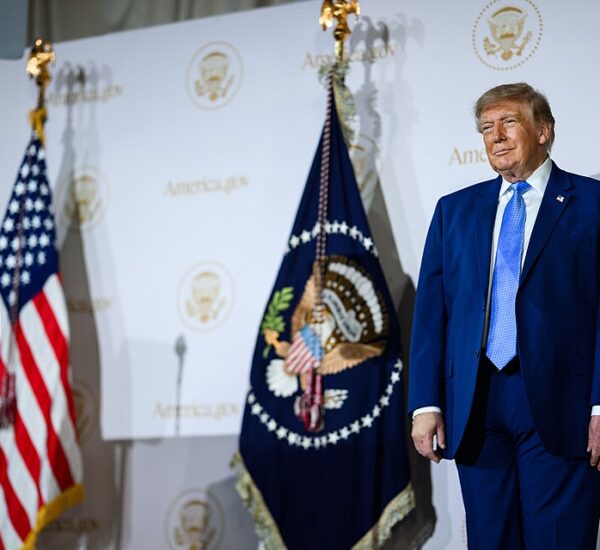
Former President Joe Biden used a recent speech to sharply criticize President Donald Trump, accusing his administration of “narcissism and incompetence” while also alleging widespread corruption. Biden specifically targeted Trump’s projects, including putting his name on the Kennedy Center, plans for a large arch in Washington, D.C., and changes to the Lincoln Memorial Reflecting Pool.
BACKGROUND:
During the speech, Biden argued that the Reflecting Pool project represented what he described as corruption “on a scale never seen before in American history.” After finishing his remarks, the 83-year-old former president needed assistance finding his way off the stage. The moment followed another widely discussed appearance in April 2026 at Syracuse University, where Biden repeatedly urged Chairman of the Board of Trustees Jeffrey M. Scruggs to return to the podium because Biden believed he resembled former President Barack Obama. The exchange drew laughter from the audience as Scruggs smiled, shook his head, and took the comments in stride.
Lawmakers Press Trump Team Over Iran
Congressional scrutiny of the Trump administration’s temporary agreement with Iran intensified Monday as Secretary of State Marco Rubio and U.S. special envoy Steve Witkoff defended the deal during closed-door briefings with lawmakers from both parties. Members of Congress pressed the administration for answers about Iran’s nuclear program, sanctions relief, and the long-term impact the agreement could have on U.S. national security.
The briefings marked the first time Rubio and Witkoff addressed a broad group of lawmakers since the United States and Iran signed a memorandum of understanding (MOU) on June 17 to halt hostilities temporarily while negotiations continue.
The agreement establishes a 60-day framework designed to give both sides time to negotiate a permanent deal. Under its terms, Iran agreed to make its best efforts to keep commercial shipping moving safely through the Strait of Hormuz, while the United States agreed to lift its naval blockade of Iranian ports.
Republicans Demand Answers on Iran’s Nuclear Program
Although Democrats raised many of the toughest questions, Republicans also sought greater clarity on the administration’s strategy for preventing Iran from advancing its nuclear capabilities.
According to reports, Darrell Issa questioned Rubio and Witkoff about what would happen to Iran’s stockpile of highly enriched uranium, which experts say is approaching weapons-grade purity.
The administration reportedly reaffirmed that any final agreement must prevent Iran from retaining highly enriched uranium. Officials also disclosed that technical negotiators had traveled from Switzerland to Qatar ahead of another round of negotiations expected to begin Tuesday.
For many lawmakers, ensuring Iran cannot develop a nuclear weapon remains one of the central tests of any future agreement.
Democrats Question Potential Sanctions Relief
Democratic lawmakers concentrated much of their questioning on the financial benefits Iran could receive under the temporary agreement, particularly whether Tehran would regain access to revenue from previously restricted oil exports.
According to multiple reports, Debbie Wasserman Schultz engaged in an extended exchange with Rubio and Witkoff regarding oil sanctions before officials eventually concluded the discussion.
Meanwhile, Madeleine Dean raised concerns about Witkoff’s private business interests in the Middle East while serving as the administration’s chief negotiator. Rubio strongly defended Witkoff against those concerns during the briefing.
Schumer Calls for Public Testimony
During a separate classified briefing for senators, Chuck Schumer questioned Rubio and Witkoff about the administration’s decision to ease certain oil sanctions.
After the meeting, Schumer claimed the officials acknowledged Iran could ultimately receive billions of dollars in future oil revenue while still maintaining considerable leverage over shipping through the Strait of Hormuz.
Schumer argued that if those positions accurately reflect administration policy, Rubio should explain them publicly under oath before the Senate Foreign Relations Committee rather than limiting discussions to private briefings. He criticized Monday’s briefing as lacking meaningful detail.
Administration officials rejected that criticism, noting Schumer had already received an earlier national security briefing alongside other congressional leaders and was given additional opportunities to ask follow-up questions during Monday’s session.
Republicans Seek More Transparency
While Republican lawmakers generally described the discussions as productive, several indicated they are still waiting for additional details.
Steve Daines called the Senate briefing a productive conversation but acknowledged that much of the information repeated what administration officials had already shared during an earlier meeting hosted by Vice President JD Vance.
Later Monday, White House officials also held a classified briefing with congressional leadership and key committee chairmen to discuss the ongoing negotiations and broader security concerns in the Middle East.
Administration Defends the Agreement
Rubio and Witkoff also addressed concerns surrounding the gradual reopening of the Strait of Hormuz following weeks of military tensions.
According to the administration, additional mine-clearing operations must be completed before commercial traffic can safely return to normal levels.
Witkoff also reportedly told lawmakers that Iran violated part of the temporary agreement by launching a drone attack against a commercial vessel over the weekend, raising new questions about Tehran’s willingness to fully honor the ceasefire.
Despite those concerns, administration officials insisted that Iran has not received any American taxpayer money under the memorandum.
Officials also reiterated that a previously discussed $300 billion reconstruction initiative would not be financed by the United States, pushing back against concerns that American taxpayers could ultimately bear the cost of rebuilding efforts.
What Comes Next?
Negotiations between the United States and Iran are expected to continue in Qatar as both sides work toward a more permanent agreement before the 60-day framework expires.
In the meantime, lawmakers from both parties are signaling they want far greater transparency from the administration regarding the negotiations, the future of Iran’s nuclear program, and the scope of any sanctions relief.
With national security, global energy markets, and stability throughout the Middle East all hanging in the balance, Congress is expected to maintain close oversight as the next phase of talks unfolds.

who is that lying cheat pervert obiden to say anything about someone else