The mainstream media ignored 4 years of nonstop Biden mistakes but pounce on President Trump for just one.
President Donald Trump is once again facing criticism over a brief moment during a public speech, this time involving the pronunciation of a single word while discussing his mental sharpness.
The incident reportedly occurred as Trump spoke about his performance on cognitive examinations, a subject he has repeatedly raised while defending his health and ability to serve as president.
Critics focused on an apparent stumble over the word “cognitive,” pointing to the irony of a pronunciation mistake occurring during a discussion about intelligence.
The controversy has renewed a familiar debate surrounding the president: Should an occasional speaking mistake become a major political issue, or should public officials be evaluated on a broader record of performance?
Trump Makes Bold Statement About His Intelligence
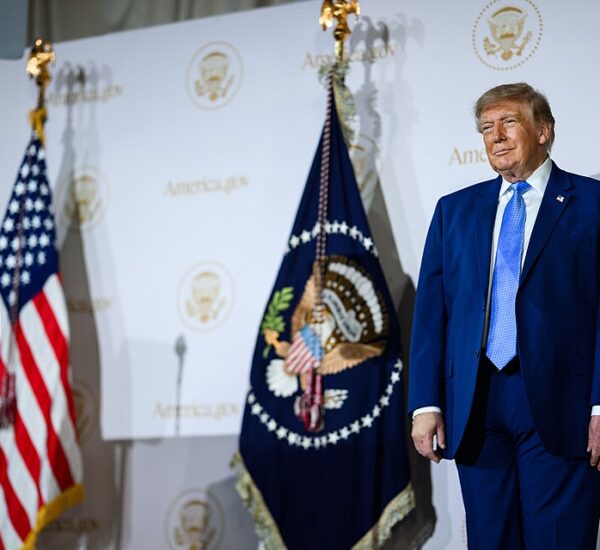
During an October 14, 2026, rally in Bullhead City, Arizona, Trump discussed the cognitive examinations he says he has successfully completed.
Speaking to supporters, the president described memory exercises used during his medical evaluations and explained how he performed on the tests.
Trump said he had received perfect results and emphasized his ability to remember a series of unrelated words.
He also expressed confidence that relatively few people could match his performance.
At one point, Trump described himself as a “frickin’ genius,” a remark that quickly attracted attention from political commentators and news outlets.
His comments came as he campaigned for Republican candidates ahead of the November midterm elections.
Rather than focusing exclusively on the upcoming vote, part of the speech centered on his health, intelligence, and past medical examinations.
Critics Seize On Apparent Verbal Mistake
Following the appearance, reports highlighted an apparent difficulty pronouncing the word “cognitive.”
The reported mistake drew particular attention because Trump was discussing his own mental abilities.
Critics used the moment to question the president’s repeated claims about his intelligence and performance on cognitive examinations.
Late-night television host Jimmy Kimmel also mocked Trump’s remarks about the tests, adding to the public discussion surrounding the speech.
However, there is an important distinction between making a verbal mistake and demonstrating a medical problem.
People occasionally stumble over words during conversations, interviews, and public presentations.
A single pronunciation error, without additional medical evidence, does not establish that someone has a cognitive disorder.
The episode therefore raises questions not only about Trump’s remarks but also about how political figures are scrutinized in today’s media environment.
WATCH:
Trump suggests his supporters would have a hard time passing a cognitive test: There are few people in this audience that can…. https://t.co/cOt7T5r15L
— Acyn (@Acyn) October 14, 2026
What Trump Said About His Cognitive Tests
Trump has repeatedly discussed undergoing cognitive examinations during his medical checkups.
At the Arizona rally, he described exercises involving memory, word recall, and other basic mental tasks.
The president maintained that he had performed exceptionally well.
One widely used examination is the Montreal Cognitive Assessment, also known as the MoCA.
This screening tool helps healthcare professionals evaluate several mental abilities, including attention, memory, language, and certain problem-solving skills.
Patients may be asked to remember words, identify animals, perform calculations, or complete simple drawing exercises.
The assessment is designed to help identify possible cognitive difficulties. It is not an IQ test and does not determine whether someone possesses exceptional intelligence.
That distinction is important when evaluating political claims about medical test results.
Although Trump has highlighted his reported strong performances, those results should be understood in the context of what the examinations actually measure.
Presidential Health Remains Under Scrutiny
At 80 years old, Trump is serving in one of the most demanding positions in the federal government.
The presidency involves major decisions concerning national security, economic policy, foreign relations, and domestic affairs.
As a result, questions about a president’s physical and mental health are legitimate matters of public interest.
Former President Joe Biden also faced extensive scrutiny concerning his age, public appearances, and verbal mistakes while serving in the White House.
The attention directed toward both presidents illustrates how presidential age has become an increasingly prominent political subject.
Supporters of greater health transparency argue that Americans deserve reliable information about the people entrusted with leading the country.
Others caution that isolated clips, occasional misstatements, and unverified speculation can create misleading impressions.
Both considerations matter when evaluating reports about a president’s health.
A more complete assessment requires credible medical information and an examination of the president’s ability to perform official duties.
Public Speaking Mistakes Are Nothing New
Presidents from both political parties have occasionally made verbal mistakes during public appearances.
Speaking for extended periods without reading every word from a prepared script creates opportunities for mispronunciations, forgotten phrases, and unexpected wording.
In the modern media environment, even brief incidents can spread rapidly.
Video clips and headlines frequently emphasize particularly memorable moments, sometimes without the full context of a speech.
Trump’s highly recognizable speaking style receives especially close attention because he often speaks at length and moves between prepared political messages and spontaneous commentary.
These moments can generate substantial public discussion, even when the original incident lasts only a few seconds.
The latest controversy is another example of how quickly attention can shift from the central message of a political event to a single remark.
Political Attention Turns Toward The Midterms
The timing of the controversy is also significant.
With the November 3, 2026, midterm elections approaching, Trump has been campaigning to help Republicans maintain political influence in Washington and across the country.
The outcome will determine control of Congress and affect the administration’s ability to advance its legislative priorities.
Trump’s Arizona appearance was intended to promote Republican candidates, including Andy Biggs, who is seeking the governorship.
Yet coverage of the president’s cognitive test remarks became another storyline emerging from the event.
Whether the reported pronunciation mistake will have any lasting political significance remains unclear.
One Mistake Becomes A National Discussion
The latest criticism reflects the heightened attention surrounding nearly every public appearance by the president.
Trump maintains that he has performed well on cognitive examinations, while critics continue to question the significance of his claims and closely examine his public statements.
The reported verbal stumble has now become another example of the broader debate surrounding presidential health, media criticism, and political accountability.
Ultimately, an occasional pronunciation mistake is not enough to establish a person’s cognitive condition.
For Americans evaluating their elected leaders, verified medical information, presidential judgment, and overall job performance provide a more meaningful basis for assessment than a single moment behind a microphone.