This was a strange decision.
Vice President JD Vance delivered a surprising show of support for Republican Sen. Susan Collins on Monday, praising one of President Donald Trump’s most independent-minded GOP senators even as Collins stayed away from his Maine appearance.
The unusual political moment comes at a critical time for Republicans.
Collins is fighting to keep her Senate seat in a state where Republicans cannot necessarily depend on Trump’s popularity alone. And with control of the U.S. Senate potentially at stake in the 2026 midterm elections, national Republicans have plenty of reasons to keep Collins in office — despite her long history of breaking with Trump.
Vance made that reality clear while speaking in Brewer, Maine.
Vance Praises Susan Collins Despite Differences
Vance acknowledged that Collins does not always make life easy for Republican leaders in Washington.
He joked that Collins’ fiercely independent approach sometimes makes his own responsibilities as president of the Senate more difficult.
But instead of criticizing the Maine Republican, Vance praised her willingness to put the interests of her constituents ahead of party politics.
According to Vance, Collins consistently focuses on one central question when dealing with Washington: How will a particular policy affect Maine?
The vice president said Collins has visited his Naval Observatory residence in Washington roughly half a dozen times and repeatedly pressed him about the details of federal policies affecting her home state.
Vance portrayed those conversations as evidence that Collins remains intensely focused on Maine voters rather than simply following instructions from Republican leadership.
He concluded his remarks about Collins by calling her a “very independent friend” and asking the audience to applaud her.
For Republicans, that independence could prove both an advantage and a source of frustration as November approaches.
Collins Was Missing From Vance’s Maine Visit
There was one notable problem with Vance’s endorsement: Collins wasn’t there to hear it.
The 73-year-old senator, who has represented Maine since 1997, said before the event that she already had something scheduled for Monday and therefore could not join the vice president.
Her office did not immediately publicly detail the nature of the scheduling conflict.
The absence attracted additional attention because Collins has repeatedly separated herself from Trump on some of the biggest political fights of his career.
Most significantly, Collins voted to convict Trump during his second impeachment trial in 2021.
She has also challenged the president on a variety of policy matters, reinforcing the independent political brand that has helped her survive for decades in a state that can be difficult territory for Republicans.
Despite those disagreements, Vance’s message Monday was unmistakable: Republicans still need Collins.
Why Republicans Need Collins In The Senate
The stakes extend well beyond a single Senate race in Maine.
Maintaining control of the Senate is crucial to Trump’s ability to advance his agenda during the remaining years of his presidency.
A Republican Senate can help move legislation and, critically, confirm the president’s choices for federal courts and executive branch positions.
A Democratic takeover could dramatically change that equation.
Democrats would gain considerably more power to stop or delay Trump nominees, challenge Republican legislative priorities and launch congressional investigations into the administration.
That makes Collins’ reelection campaign strategically important even when she disagrees with Trump.
For Republicans, the calculation is straightforward: An unpredictable Republican vote can still be far more valuable to the party than handing the seat to a Democrat.
Collins Breaks With Trump Over Canada Tariffs
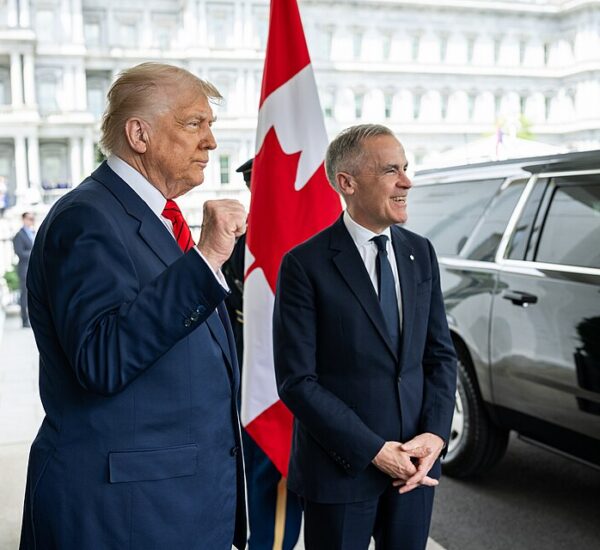
The political contrast became even more apparent Monday when Collins publicly criticized Trump’s escalating tariff battle with Canada.
Collins described the new tariffs as a mistake and warned that Maine could feel the economic consequences more than many other states because of its close commercial ties to Canada.
Maine produces some of America’s best-known blueberries, potatoes, lobster and lumber. Some of those goods cross the northern border as part of the production and processing chain.
Collins argued that imposing substantial tariffs on products returning to the United States could ultimately increase prices for consumers and businesses.
That could affect everything from groceries to home construction while creating additional problems for Maine companies trying to sell the state’s signature products.
Her criticism puts her directly at odds with Trump’s approach to Canada at the same time that his vice president is publicly encouraging Republicans to support her.
It is an unusual arrangement, but one that demonstrates the complicated political reality facing the GOP in Maine.
Collins Has Kept Her Distance Before
Monday was not the first time Collins missed a Vance appearance in her state.
She also stayed away when Vance visited Bangor in May, although the Senate was conducting business in Washington at the time.
This week’s circumstances were different because Congress is currently in its traditional August recess.
Still, Collins has spent decades building a political identity separate from the national Republican Party.
That strategy may become particularly important as she attempts to win another term in November.
Democrats Target A Crucial Republican Seat
Democrats have nominated former Maine state lawmaker Troy Jackson to take on Collins.
Jackson entered the general-election fight after the party’s previous nominee, Graham Platner, abandoned his candidacy amid serious controversies.
Now Democrats see an opportunity to defeat one of the longest-serving Republican senators in Washington — and potentially move closer to taking control of the Senate.
Jackson quickly seized on Vance’s praise of Collins.
Following the event, the Democrat argued on social media that Collins’ reputation for independence does not tell the entire story, pointing to her support for much of Trump’s agenda.
That argument is likely to become a central Democratic attack heading into November: Collins may publicly disagree with Trump on prominent issues, but Democrats will contend that she still provides Republicans with an important vote in Washington.
Republicans, meanwhile, have a different case to make.
Collins’ willingness to challenge her own party could help her appeal to Maine voters who might otherwise be reluctant to support a Republican candidate.
Maine Could Help Decide Trump’s Final Two Years
That is what makes Vance’s endorsement especially significant.
The vice president isn’t pretending that Collins agrees with the Trump administration on everything. In fact, he openly acknowledged that her independence can make his job more difficult.
He endorsed her anyway.
The reason may ultimately come down to Senate arithmetic.
Republicans cannot afford to casually surrender competitive seats if they hope to maintain control of the chamber. Losing the majority could fundamentally reshape Trump’s ability to govern during the final two years of his term.
Collins therefore occupies an unusual position in today’s Republican Party.
She has opposed Trump on some major issues, criticized his policies and cultivated an identity independent of the MAGA movement.
Yet when Vance arrived in Maine, he didn’t attack her for those disagreements.
He asked Republicans to applaud her.
And with the battle for the Senate intensifying, that moment offered a revealing glimpse at what may matter most to the GOP in November: keeping the majority.