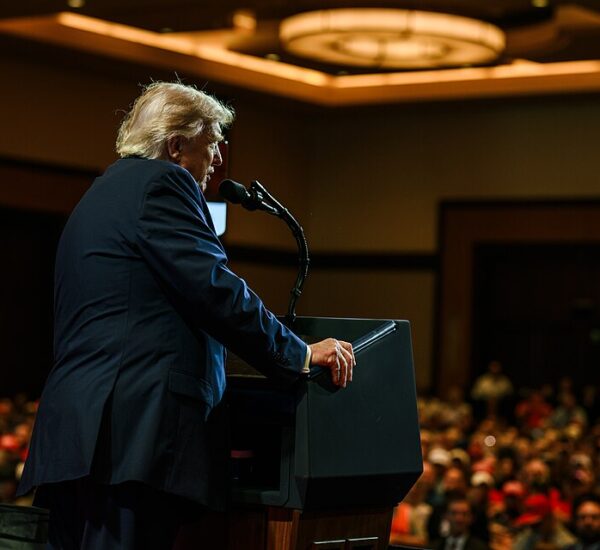
Do they really think they can bring down President Trump and his MAGA movement?
Former Republican Rep. Marjorie Taylor Greene and conservative commentator Tucker Carlson are fueling new speculation about the future of the Republican Party after signaling support for a potential third-party movement. Their latest meeting has sparked fresh debate among conservatives over the direction of the America First movement and U.S. foreign policy.
On Saturday, Greene shared a photo on social media showing herself alongside her husband, Brian Glenn, seated around a table with Carlson. Also joining the gathering were Rep. Thomas Massie (R-Ky.), former National Counterterrorism Center Director Joe Kent, and Kent’s wife.
While the atmosphere appeared relaxed—with chocolate chip cookies and glasses of milk on the table—Greene suggested the discussion focused on building a political movement centered on domestic priorities.
Greene said she and her supporters backed Trump because they believed his pledge to keep the United States out of additional foreign conflicts. She argued that the president has since abandoned that commitment, leaving many of his former allies feeling let down.
She added that the group’s goal remains an “America First” agenda designed to put American interests ahead of overseas conflicts.
Greene said the group’s mission is to advance an “America First” agenda that she believes can unite Americans regardless of their political affiliation. She ended her message by declaring that “the movement has begun.”
The meeting comes roughly one month after Carlson revealed that he was helping develop a new third-party effort. According to Carlson, many voters have grown frustrated with both Republicans and Democrats, arguing that Washington spends too much time focused on international issues while Americans continue facing inflation, rising living costs, and other challenges at home.
Carlson had previously announced that he no longer intended to vote for Republican candidates, and Greene later echoed similar concerns, signaling growing dissatisfaction with the party’s direction.
Carlson questioned why any American would support a political party that, in his view, places another nation’s interests ahead of those of the United States. He said he could no longer vote for candidates he believes fail to put American citizens first.
Carlson’s criticism has largely focused on U.S. policy toward Israel. He has argued that support for Israel has had significant influence over American foreign policy and has questioned whether recent decisions fully reflect U.S. national interests. Those views have generated sharp debate among conservatives and Republicans.
President Donald Trump has rejected those arguments. Speaking earlier this year about the conflict involving Iran, Trump responded to criticism by saying, “If anything, I might’ve forced Israel’s hand.”
Whether Greene, Carlson, Massie, and Kent ultimately move forward with a formal political party remains to be seen. However, their increasingly public alliance highlights a growing divide inside the conservative movement over foreign policy, government spending, and the future of the Republican Party.
As the 2026 election cycle continues to unfold, disagreements over America’s role overseas and the priorities of the America First movement are likely to remain at the center of the national political conversation.