Here’s what Trump needs.
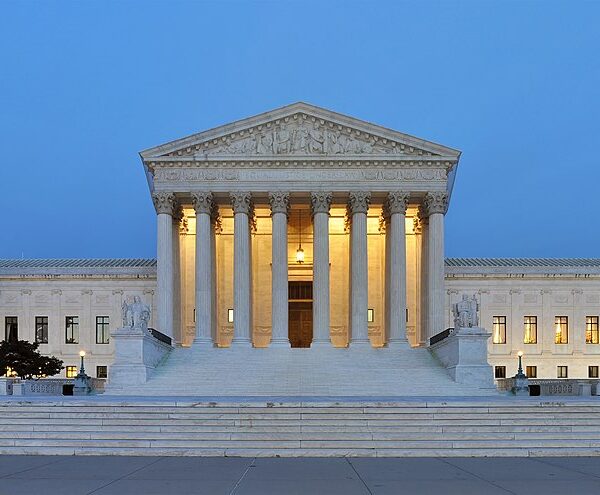
President Donald Trump is preparing to ask the U.S. Supreme Court to intervene in the growing legal battle over his proposed White House ballroom, setting up another potentially important fight involving presidential authority, Congress and the federal courts.
Trump’s plans suffered a setback after a divided federal appeals court upheld an order preventing above-ground construction from moving forward. The D.C. Circuit ruled 2-1 that the project cannot proceed under the current circumstances without congressional approval.
But the legal battle may be far from over.
Trump announced Friday that he intends to take the dispute to the Supreme Court, where a procedural issue involving the group challenging the ballroom could potentially give his administration another path forward.
Rather than deciding the much broader question of whether Trump has the authority to proceed with the project, the Supreme Court could focus on something more fundamental: whether the plaintiffs have the legal right to bring the lawsuit at all.
For Trump, that distinction could prove crucial.
Trump Points to Key Dissent in White House Ballroom Case
Trump highlighted the dissenting opinion from Judge Neomi Rao, whom he appointed to the D.C. Circuit during his first presidential term.
Rao disagreed with the court’s majority and argued that the National Trust for Historic Preservation had failed to establish sufficient legal standing to challenge the project.
Standing is an important requirement in federal lawsuits.
Generally speaking, a person or organization cannot ask a federal court to block government action merely because it disagrees with a policy or decision. The plaintiff must demonstrate a sufficiently concrete injury connected to the action being challenged.
That requirement could become one of the most important issues if the White House ballroom case reaches the Supreme Court.
National Trust Bases Argument on White House Visitor
The National Trust’s standing argument relies in part on Alison Hoagland, a member who lives near the White House and regularly visits President’s Park.
According to the lawsuit, Hoagland visits the area approximately once per month and believes the proposed ballroom would negatively affect her experience.
Her concern centers on the project’s appearance.
She maintains that the ballroom’s size and design could overshadow the historic White House and reduce her enjoyment of the surrounding area.
Rao was not convinced that this amounted to the type of concrete injury necessary for federal courts to step into the dispute.
In her dissent, Rao argued that the lower court placed too much importance on the aesthetic objections of an individual visitor while giving insufficient weight to government concerns involving security and an unfinished construction site at the president’s residence and workplace.
That disagreement could become central to Trump’s Supreme Court appeal.
Legal Standing Could Become Trump’s Strongest Argument
Former Justice Department attorney Abhishek Kambli told Fox News Digital that the National Trust could have difficulty establishing standing before the Supreme Court.
Although Congress created the National Trust, its congressional origins do not necessarily provide unlimited authority to challenge federal construction decisions.
Kambli pointed out that the organization owns some historic properties, but President’s Park is not one of them.
That could complicate its case.
The Supreme Court has repeatedly dealt with disputes over legal standing, and the justices could decide that the alleged injury in this case is too indirect to satisfy constitutional requirements.
If that happens, the larger disagreement over Trump’s ballroom could remain unanswered.
Does Disliking the View Create Legal Standing?
Another important question involves the concept of “aesthetic injury.”
Kambli suggested that this type of claim is generally stronger when a plaintiff actually uses the property being affected.
For example, someone who regularly uses a particular park, trail or recreational area could potentially make a stronger argument that a government project directly interferes with his or her enjoyment of that property.
The Trump ballroom dispute is different.
The National Trust’s member is essentially arguing that her experience around the White House would be diminished by seeing the new structure.
Whether that is enough to establish standing could become an important question for the Supreme Court.
Kambli suggested that simply passing by the property and objecting to how a new structure changes the surrounding view could be a considerably more difficult argument.
Earlier White House Case Raised Similar Question
The issue has already surfaced in another recent dispute involving activities at the White House.
In July, U.S. District Judge Amit Mehta, an appointee of former President Barack Obama, rejected a lawsuit seeking to stop the America 250 UFC event at the White House.
Mehta concluded that the plaintiffs in that case had not demonstrated sufficient aesthetic harm to establish standing.
The two cases are not identical, and one ruling does not automatically determine the outcome of another dispute.
Still, the earlier decision demonstrates why standing can become decisive before courts ever consider the larger political or constitutional controversy behind a lawsuit.
Supreme Court Precedent Could Help Trump
Hans von Spakovsky, a senior legal fellow at Advancing American Freedom, also believes Trump has a strong argument on standing.
He pointed to Supreme Court precedent requiring plaintiffs to demonstrate a concrete and actual injury before bringing certain claims in federal court.
Von Spakovsky questioned whether someone’s dissatisfaction with the appearance of a White House addition would meet that standard.
That could present Trump’s lawyers with a straightforward argument:
Before deciding whether the president has authority to build the ballroom, the courts must first determine whether the people challenging the project have a legitimate basis for being there.
If the answer is no, the case could end without the Supreme Court addressing the broader dispute.
Supreme Court Could Avoid Major Constitutional Showdown
That possibility could be particularly important for the Trump administration.
The Supreme Court generally does not have to decide a sweeping constitutional or statutory question when a case can be resolved through a narrower legal issue.
If the justices determine that the National Trust lacks standing, they could dismiss the challenge without deciding exactly how much authority Trump has to alter or expand the White House complex.
Such an outcome could effectively eliminate this particular legal roadblock while leaving the larger separation-of-powers debate unresolved.
Von Spakovsky also questioned whether another private party could demonstrate the type of direct injury necessary to bring a similar lawsuit.
Congress could potentially present a different legal argument, but political divisions in the House and Senate could make a coordinated congressional challenge difficult.
Congress and Trump Administration Clash Over Federal Law
Even if Trump wins the standing argument, an important legal dispute remains underneath the case.
The National Trust contends that federal law requires Congress to approve new construction on federal property in Washington, D.C.
The Trump administration interprets the law differently.
According to the administration’s position, existing federal law already provides sufficient authority for a president to make alterations and improvements to federal property, including the White House.
The disagreement therefore turns partly on how Trump’s ballroom should legally be classified.
Is it an entirely new structure that requires specific approval from Congress?
Or is it an improvement or alteration to an existing federal property that the executive branch already has authority to undertake?
The answer could have implications extending beyond this particular construction project.
What Counts as an “Improvement” to the White House?
Kambli agreed with Rao’s interpretation of the relevant language and argued that words such as “alteration” and “improvement” should be understood using their ordinary meaning in real estate.
He offered the example of adding an extension to a private residence.
A homeowner who expands an existing house has not necessarily created a completely separate house. The addition could instead be viewed as an improvement to the original property.
The same reasoning could apply when interior walls are removed or rooms are substantially redesigned. The building remains the same property even though significant changes have been made.
Trump’s legal team could use similar reasoning to argue that the ballroom is an improvement to the existing White House complex rather than an entirely separate federal construction project.
Opponents are likely to continue arguing that the scope of the ballroom goes beyond an ordinary alteration and therefore requires congressional involvement.
That distinction sits at the heart of the broader legal fight.
Trump May Have Two Ways to Win
The president could ultimately have two separate paths to victory if the case reaches the Supreme Court.
The first concerns standing.
If the National Trust cannot prove that it has suffered the type of injury required to bring the lawsuit, the Supreme Court could dismiss the challenge on procedural grounds.
The second concerns presidential authority.
If the justices reach the merits of the dispute, Trump’s lawyers could argue that existing federal law gives the executive branch sufficient authority to make improvements and alterations to the White House.
The standing question may offer the narrower route.
A ruling on those grounds would allow the Supreme Court to resolve the immediate lawsuit without issuing a sweeping decision about the balance of power between Congress and the president.
White House Ballroom Fight Is Not Over
Trump still faces a significant legal obstacle.
The appeals court ruled against his administration by a 2-1 margin, and the Supreme Court is not required to accept every appeal presented to it. Even if the justices agree to consider the dispute, there is no guarantee of how they would ultimately rule.
Nevertheless, Rao’s dissent has provided the administration with a potentially important argument as Trump looks toward the nation’s highest court.
The dispute also raises questions extending beyond the ballroom itself.
How far does presidential authority over the White House extend? When does an alteration become “new construction”? When must Congress approve changes to federal property? And who has the legal right to challenge those decisions?
Those questions could determine what happens next.
For Trump, however, the most important issue may be the simplest one.
Before his opponents can convince the Supreme Court that the White House ballroom is unlawful, they may first have to convince the justices that they have the legal standing necessary to challenge it at all.
That threshold issue could ultimately determine whether Trump’s White House ballroom project remains tied up in court — or gets another opportunity to move forward.