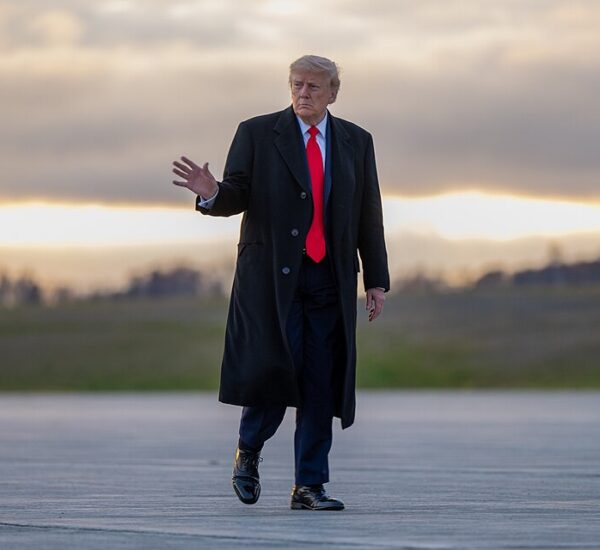
President Trump issued a shocking warning.
President Donald Trump is sending a strong message to France following a weekend of violent riots, widespread property damage, and thousands of arrests. The American president is urging French leaders to close their borders immediately as concerns grow over public safety, immigration, and the government’s ability to maintain law and order.
The warning comes after several major French cities experienced serious unrest, with businesses vandalized, public buildings damaged, and police officers facing violent confrontations.
Trump pointed directly to immigration as a major concern, declaring that migrants had taken over France and calling for urgent border enforcement.
His remarks have sparked a wider international discussion about border security, national sovereignty, and whether European governments are doing enough to protect their communities.
Trump Calls for Immediate Border Action
On Monday, October 19, Trump addressed the situation in France through his Truth Social platform, criticizing the country’s handling of immigration and demanding tougher action.
The president’s message was unmistakable: France should strengthen its borders before the situation deteriorates further.
Trump’s statement followed a chaotic weekend during which demonstrations turned violent in cities including Paris, Marseille, Lyon, and Lille.
French authorities reported approximately 2,400 arrests as police worked to restore order following widespread confrontations, property destruction, and looting.
The unrest also resulted in damage to thousands of businesses, leaving shop owners and residents dealing with substantial losses.
For many French families, the immediate concern is not political disagreement but whether their neighborhoods, businesses, and public spaces can remain safe.
Violent Riots Leave French Cities Struggling
The demonstrations originally emerged from frustration over the rising cost of living, inadequate school facilities, and concerns about government spending.
However, what began as public protests escalated when groups of rioters engaged in destructive behavior.
Authorities reported fires, vandalism, damaged storefronts, and attacks on public property.
One of the most significant incidents involved a major fire at the historic city hall in Limoges, where extensive damage highlighted the severity of the unrest.
The destruction extended beyond government property, affecting local businesses and commercial districts where owners now face the difficult process of rebuilding.
For residents whose livelihoods depend on small businesses, the violence represents a serious economic and personal setback.
French authorities have attributed much of the disorder to radical groups and individuals involved in criminal activity.
Although Trump has emphasized immigration, available reporting indicates that the causes of the unrest are more complicated than border policy alone.
French Government Responds With Tougher Security Measures
French President Emmanuel Macron condemned the violence and called for stronger efforts to restore public order.
Prime Minister Sébastien Lecornu supported localized curfews and increased security measures in areas affected by the disturbances.
Authorities introduced restrictions in several locations to discourage additional gatherings that could lead to further violence.
The security response has also raised questions about whether officials were adequately prepared for the scale of the unrest.
French Interior Minister Laurent Nuñez offered his resignation amid criticism of the government’s handling of the crisis, but Macron declined to accept it.
The president instead called for a review of policing strategies and intelligence failures.
These developments have placed additional pressure on French leadership during an already challenging period of political and economic uncertainty.
Immigration and Border Security Return to the Spotlight
Trump’s comments have renewed attention on France’s immigration policies and the broader debate over how European countries manage their borders.
France belongs to the Schengen Area, an agreement that generally allows travelers to move between participating European countries without routine passport checks at internal borders.
Under certain circumstances, member countries can temporarily restore border controls to address security concerns.
However, closing borders would not necessarily resolve the domestic economic, educational, and political disputes that helped trigger the latest demonstrations.
Trump has long argued that strong border enforcement is essential to protecting national security and maintaining government control over immigration.
His statement about France reflects that broader position, although French officials have not established that migrants as a group were responsible for the unrest.
The disagreement highlights two competing questions facing governments across Europe: how to improve domestic public services and how to maintain effective immigration and security policies.
Growing Concerns Over Public Safety and Government Accountability
Beyond the political debate, the riots have created significant challenges for ordinary French citizens.
Businesses that were damaged or looted face repair costs, interrupted operations, and uncertainty about future security.
Families living near affected areas have also experienced disruptions as authorities impose restrictions and increase police patrols.
The situation has prompted international travel warnings and raised concerns about the potential for further demonstrations.
At the same time, French authorities must balance the right to peaceful protest with their responsibility to prevent violence and protect property.
The distinction is important because most demonstrations do not involve criminal behavior, and participation in lawful protests remains a fundamental democratic right.
The challenge for French leaders is to address public dissatisfaction while preventing violent groups from exploiting broader social concerns.
What Happens Next for France?
France now faces the difficult task of restoring public confidence while addressing the issues that contributed to the nationwide demonstrations.
Macron’s government is under pressure to strengthen security, assist damaged businesses, and respond to concerns about living expenses and public services.
The unrest could also influence France’s political future as the country approaches its 2027 presidential election.
Meanwhile, Trump’s warning has ensured that immigration and border enforcement remain part of the international conversation.
Whether France introduces additional border restrictions remains uncertain, and any such measures would involve legal, economic, and diplomatic considerations.
What is clear is that French authorities face growing expectations to protect their communities, restore stability, and prevent another weekend of widespread destruction.
As the situation develops, the debate over national security, immigration, and government responsibility is unlikely to disappear.