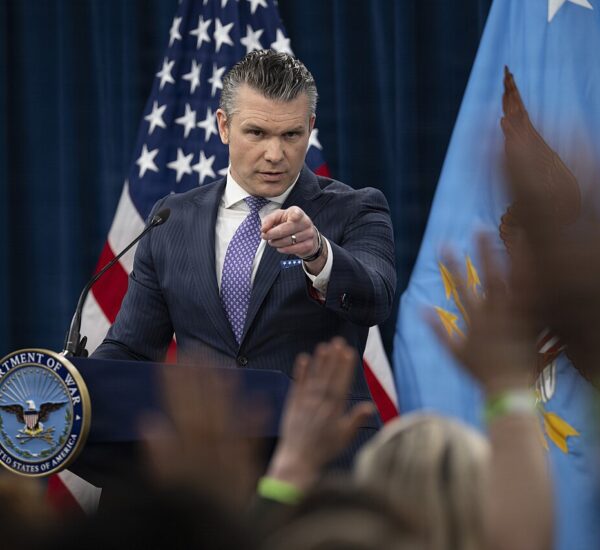
Here’s what the Trump team is planning.
The Pentagon has confirmed it has ordered a sweeping review of women serving in ground combat roles—nearly a decade after those positions were first opened across the U.S. military.
Defense officials insist the review is not about politics or ideology, but about combat readiness and maintaining the strongest fighting force in the world. Still, critics are already claiming the move could signal major changes for women in frontline military jobs under President Donald Trump.
Pentagon Orders Combat Effectiveness Review
According to the Department of Defense, the review will examine whether ground combat units are meeting the highest operational standards after ten years of integrating women into infantry and other physically demanding roles.
The study is being conducted by the Institute for Defense Analyses, an independent organization that provides national security analysis to the U.S. government.
Pentagon press secretary Kingsley Wilson said the purpose is simple: ensuring America’s military remains the most capable and lethal force on Earth.
“The focus is on readiness, performance, and deployability,” Wilson said. “This department will not weaken standards to satisfy quotas or political agendas.”
What the Military Is Being Asked to Report
The review directive, first reported by NPR, instructs the Army and Marine Corps to submit detailed data on:
- Physical readiness and training outcomes
- Combat performance and casualty rates
- Unit cohesion and command climate
- Medical readiness and deployability
Defense officials say the goal is to evaluate real-world performance—not theoretical assumptions—after all remaining restrictions on women in combat were lifted in 2015.
Hegseth Pushes “No-Compromise” Standards
Defense Secretary Pete Hegseth has been clear about his position: combat roles must be governed by the toughest physical requirements possible, regardless of who passes—or fails.
In a closed address last year to senior military leaders in Quantico, Virginia, Hegseth emphasized that standards should reflect battlefield realities, not social pressures.
“If that means fewer people qualify for certain combat jobs, so be it,” he said.
Hegseth, an Army National Guard veteran, has long argued that lowering or adjusting combat standards risks putting American lives at stake. Before joining the Trump administration, he repeatedly warned that ideological experiments inside the military could weaken unit effectiveness.
Critics React, Pentagon Pushes Back
Left-leaning critics argue the review could be used to quietly push women out of elite combat roles. Pentagon officials strongly reject that claim, noting that current standards are already sex-neutral.
“A rucksack, a rifle, or a wounded soldier doesn’t care if you’re male or female,” Wilson said. “Combat standards must reflect reality, not politics.”
At present, women who serve in ground combat positions are required to meet the same physical and performance benchmarks as men.
Approximately 3,800 women currently serve in Army infantry, armor, and artillery units. More than 150 have completed Ranger School, and roughly ten have passed Green Beret training. In the Marine Corps, about 700 women serve in ground combat roles.
How the Policy Began
The Pentagon first announced plans to open all combat roles to women in 2013. The change was fully implemented in 2015 under then-Defense Secretary Ash Carter, who said women would be eligible “as long as they meet the standards.”
The current review does not reverse that policy—but it does reflect a renewed focus under President Trump on military strength, discipline, and winning wars rather than advancing social experiments.
The Bottom Line
Despite the headlines, the Pentagon says no one is being “removed” from their job—at least not yet. What is changing is the emphasis: performance over politics, readiness over rhetoric.
For many Americans—especially veterans and military families—the real question isn’t about gender. It’s about whether the U.S. military is being prepared to fight, survive, and win the next war.