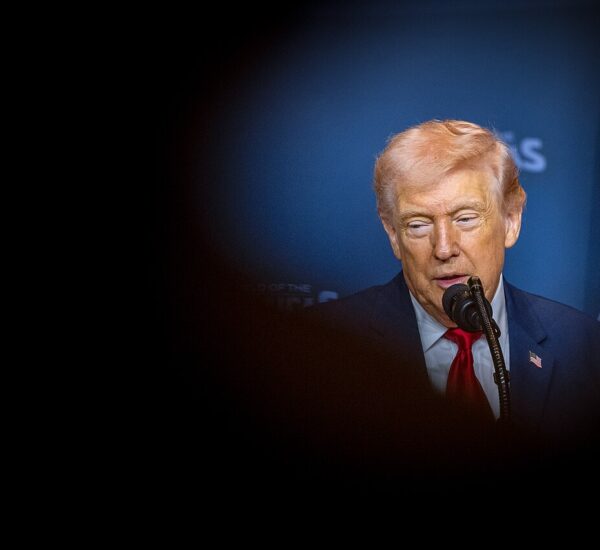
Here’s what Trump had to say.
President Donald Trump issued a stark warning over the weekend about the growing crisis surrounding the Strait of Hormuz, one of the world’s most important oil shipping routes.
Trump said the United States is prepared to lead an international effort to ensure the vital waterway remains open after Iran threatened to restrict access to the narrow passage that carries a major share of the world’s energy supply.
Trump Calls for International Naval Response
In a Saturday morning post on Truth Social, Trump said several countries may join the United States in protecting the shipping lane from Iranian interference.
Trump wrote that several nations affected by Iran’s effort to block the Strait of Hormuz could soon deploy naval forces alongside the United States to help keep the vital shipping route open and secure.
The Strait of Hormuz sits between Iran and Oman and serves as a crucial corridor for oil tankers transporting energy from the Middle East to markets around the world.
Even though the United States is now a net exporter of oil, disruptions in the strait can still affect global supply and push gasoline prices higher for American families.
Why the Strait of Hormuz Matters
Energy experts estimate that roughly one-fifth of the world’s oil supply moves through the Strait of Hormuz every day. Because the passage is so narrow, it has long been viewed as one of the most vulnerable chokepoints in global energy markets.
Trump argued that countries that rely heavily on oil shipments from the region should help defend the waterway.
“We’ve already severely weakened Iran’s military capability,” Trump wrote. “But they could still attempt disruptions using drones, mines, or short-range missiles.”
Trump specifically mentioned nations such as China, France, Japan, South Korea, and the United Kingdom as countries that could benefit from helping secure the shipping route.
Trump Promises Strong Action to Protect Oil Shipping
The president also signaled that the United States would take decisive steps if Iranian forces attempted to interfere with commercial shipping.
According to Trump, the goal is to ensure the strait remains open and safe for international trade.
“One way or another, the Hormuz Strait will soon be open, safe, and free,” Trump wrote.
Several hours later, Trump posted again, emphasizing that protecting the shipping lane should be a shared responsibility among nations that depend on Middle Eastern oil.
“The United States has already taken major steps to weaken Iran both militarily and economically,” Trump wrote. “But the countries that depend on oil moving through the Strait of Hormuz must help protect that passage. We will assist—and coordinate closely.”
Trump added that greater international cooperation could strengthen global security and stability.
“This should have always been a team effort,” he wrote.
World Leaders Respond Cautiously
So far, the countries mentioned by Trump have not publicly committed to sending naval forces to the region.
Iranian Foreign Minister Abbas Araghchi said in a television interview that Tehran maintains strong ties with countries such as China and Russia, which he described as “strategic partners.”
He suggested cooperation between those countries includes political and economic support, and possibly military coordination.
At the same time, Iranian officials have sent mixed messages about the status of the Strait of Hormuz.
Iran Sends Conflicting Signals
Iran’s Islamic Revolutionary Guard Corps has suggested the strait could remain restricted under certain circumstances. However, Araghchi indicated that most countries would still be able to use the passage.
“As a matter of fact, the Strait of Hormuz is open,” Araghchi said. “It is only closed to ships belonging to those attacking us and their allies.”
Allies Weigh Their Options
Several U.S. allies say they are carefully reviewing Trump’s proposal.
In Japan, ruling party policy chief Takayuki Kobayashi told public broadcaster NHK that Japan faces a high legal threshold before deploying its military overseas under its post-World War II constitution.
South Korea’s presidential office said it would make a decision only after a careful review of the situation.
Meanwhile, European leaders are also discussing possible steps.
French officials have explored building a multinational coalition to protect the strait once the security situation stabilizes, while British leaders say they are evaluating several options with allies to safeguard commercial shipping.
Iran’s Leadership Signals Defiance
Iran’s new Supreme Leader Ayatollah Mojtaba Khamenei, who recently took power after the death of his father, has reportedly supported keeping pressure on the shipping route.
Despite reports that he may have been injured during recent military strikes, Iranian officials insist the country’s leadership remains stable.
“There is no problem with the new supreme leader,” Araghchi said. “The system is functioning and everything is under control.”