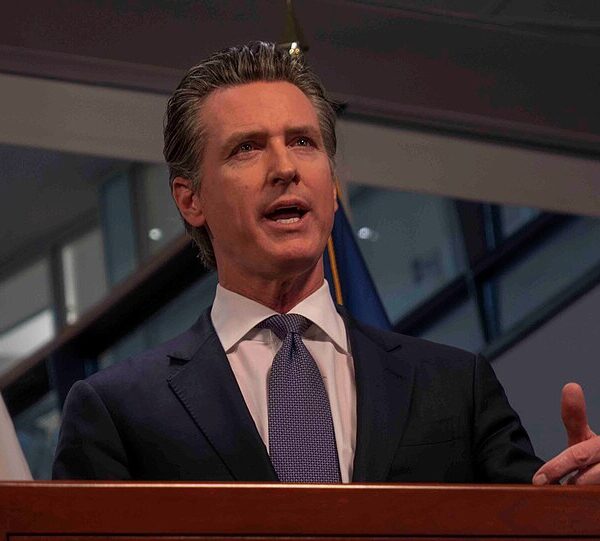
Newsom made some wild accusations.
California Gov. Gavin Newsom is escalating his criticism of President Donald Trump after the president unveiled a proposal to provide American adults with a $5,000 payment if Republicans retain control of Congress in the November midterm elections.
Newsom argued that Trump’s proposed “Trump Dividend” is less about economic relief and more about the high political stakes surrounding control of the House and Senate.
The Democratic governor even joked about the possibility of receiving the money himself, noting that his household could potentially collect $25,000 under the proposal.
But Newsom quickly turned serious, accusing Trump of making an expensive election-year promise because Republicans are facing a crucial battle to maintain their congressional majorities.
Newsom described the proposal as evidence that Trump is “desperate” to hold onto political power.
The White House, however, has pushed back against criticism of Trump’s plan and maintains that the president is focused on delivering economic benefits to Americans.
The dispute is quickly becoming another major flashpoint ahead of the November 3 midterm elections.
What Is Trump’s $5,000 Dividend Plan?
Trump announced the proposal during the Republican Party’s midterm convention in Dallas.
Under the plan outlined by the president, adult American citizens would receive a $5,000 payment if Republicans maintain control of both the House and Senate.
Trump has presented the proposed payments as a dividend Americans would receive from the country’s economic success.
He has also said the money would be spent on American goods and services, potentially directing additional consumer spending toward businesses and workers inside the United States.
However, the proposal remains just that — a proposal.
Congress has not approved the payments, and questions remain about exactly how the federal government would finance such a massive program.
With roughly 270 million adults living in the United States, providing $5,000 to each could put the total price tag at approximately $1.35 trillion.
That enormous figure has placed the proposal at the center of a broader debate over federal spending, inflation and America’s growing national debt.
Newsom Questions Trump’s Motives
Newsom offered a dramatically different interpretation of the president’s announcement.
Rather than viewing the proposed payments primarily as an economic policy, the California governor portrayed them as an attempt to persuade Americans to keep Republicans in control of Congress.
Newsom argued that Trump understands how dramatically Washington could change if Democrats capture either chamber in November.
A Democratic-controlled House or Senate could make it considerably more difficult for the president to advance major parts of his legislative agenda during the remainder of his term.
Newsom therefore claimed Trump’s dividend announcement reflects concern about losing political influence after the midterms.
The California governor also predicted strong voter turnout and framed the November elections as an important decision about the future direction of the country.
Those arguments represent Newsom’s political assessment of Trump’s motives, rather than an established explanation for why the president proposed the payments.
Trump has offered a very different explanation.
White House Defends Trump’s Record
The White House rejected Newsom’s criticism and defended the president’s broader agenda.
Administration officials argue that Trump has repeatedly overcome predictions from his political opponents and remains focused on producing results for American families.
The White House has also sought to draw a sharp contrast between Trump’s policies and those supported by Democrats, particularly on the economy, immigration, crime and foreign affairs.
Trump himself has placed enormous importance on the November elections.
At the Republican convention, he urged Americans to support GOP candidates and made his own presidency a central part of the party’s midterm message.
That strategy means the election could have consequences extending far beyond individual congressional races.
Republicans are fighting to preserve the congressional majorities needed to advance Trump’s agenda, while Democrats are seeking enough seats to gain control of at least one chamber and provide a stronger check on the administration.
Republicans Raise Questions About The Cost
Newsom and other Democrats are not the only ones questioning the $5,000 proposal.
Some Republicans and fiscal conservatives have also expressed concerns about its potential cost.
The United States is already dealing with substantial annual budget deficits and a national debt exceeding $40 trillion. Adding another program potentially costing more than $1 trillion would therefore face intense scrutiny on Capitol Hill.
There are also concerns about inflation.
Sending large amounts of money directly to consumers could increase spending across the economy. Depending on economic conditions and how the program was financed, economists have warned that such stimulus could place additional upward pressure on prices.
Supporters of Trump’s approach could counter that directing the money toward American-made goods and services would provide an economic boost to domestic businesses.
But the central question remains: Where would the money come from?
Could Tariffs Pay For The Trump Dividend?
Trump and Vice President JD Vance have pointed to tariff revenue and reductions in federal spending as possible ways to help finance payments to Americans.
Tariffs have become a major part of Trump’s economic strategy, with the president arguing that they can generate federal revenue while encouraging companies to produce more goods inside the United States.
Whether tariff revenue could generate enough money to finance payments on the scale Trump described is another matter.
A nationwide $5,000 dividend could cost approximately $1.3 trillion, depending on eligibility.
That means Congress would have to consider not only whether Americans should receive the money, but also how the government could pay for it without substantially increasing federal borrowing.
Those details could become critical if the White House turns Trump’s convention announcement into formal legislation.
Congress Would Have The Final Say
One of the most important facts for Americans to understand is that the proposed $5,000 payments are not currently guaranteed.
Presidents do not have unlimited authority to spend federal money.
Congress controls federal appropriations, meaning lawmakers would need to authorize the spending necessary for a program of this magnitude.
That could create a complicated political battle even if Republicans win the midterms.
Fiscal conservatives have spent years warning about deficits and America’s rapidly growing national debt. Asking those lawmakers to approve another trillion-dollar-plus expenditure could put them in a difficult position.
Other Republicans may see the proposal differently, particularly if they believe direct payments could provide meaningful financial relief to households dealing with elevated living costs.
Those competing priorities could produce a significant debate inside the Republican Party.
A Bigger Battle Over The Midterm Elections
The argument between Trump and Newsom ultimately extends well beyond a proposed $5,000 payment.
Control of Congress will determine how much legislative freedom Trump has during the next phase of his presidency.
If Republicans retain both chambers, the White House would have a considerably clearer path for advancing legislation.
If Democrats capture the House or Senate, they would gain greater power to block legislation, conduct investigations and challenge elements of Trump’s agenda.
That helps explain why both parties are treating the November elections as particularly consequential.
Trump is asking voters to maintain Republican control and continue advancing his administration’s policies.
Newsom and other Democrats are making the opposite case, arguing that voters should place additional limits on presidential power by changing control of Congress.
Will Americans Ever Receive The $5,000?
For now, Americans should treat the Trump Dividend as a political and policy proposal rather than money they are certain to receive.
No legislation has been enacted authorizing nationwide $5,000 payments.
Major questions about eligibility, funding, inflation, implementation and congressional support also remain unresolved.
Trump’s announcement has nevertheless accomplished one thing: It has created another major economic issue for both parties to debate heading into November.
Supporters may see the idea as a way to return money to American households and encourage spending on domestic products.
Critics may focus instead on its enormous price tag, potential effect on inflation and its connection to the outcome of the midterm elections.
And fiscal conservatives may face their own difficult question about whether direct payments are worth adding to federal spending at a time when the national debt is already historically high.
Newsom has made his position clear, portraying Trump’s proposal as a sign that the president is worried about losing power in Washington.
Trump is making a different argument: that keeping Republicans in control would allow his administration to continue pursuing its economic agenda and potentially deliver a substantial payment to American adults.
Ultimately, Congress — and before that, voters — will have a major say in what happens next.