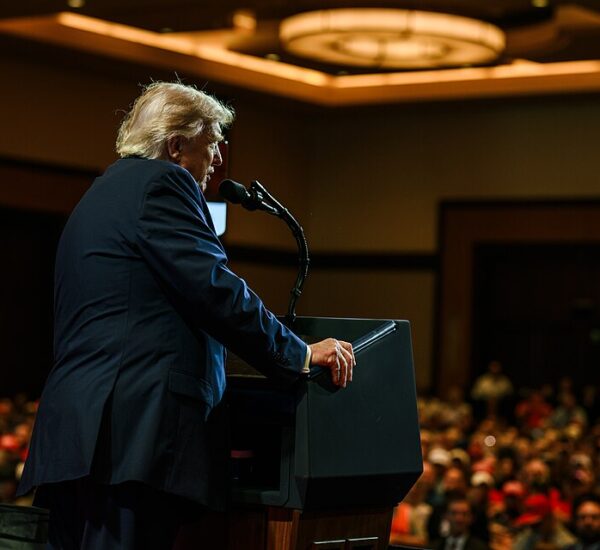
Trump Secure Huge Economic Win
The U.S. stock market has recorded significant gains during the first 20 months of President Donald Trump’s second term, giving investors another closely watched measure of how financial markets have performed under the current administration.
According to an Axios analysis published Sunday, the S&P 500 has risen approximately 27.6% from Trump’s second inauguration through Friday’s market close.
That performance is far ahead of the 2.7% gain recorded during the same 20-month period under former President Joe Biden.
However, the S&P 500’s current increase remains slightly below the 28.5% gain recorded during the comparable period of Trump’s first term and the 32.4% increase during former President Barack Obama’s presidency.
The comparison offers an important snapshot for Americans watching retirement savings, 401(k) accounts, pensions and investment portfolios as markets continue responding to corporate earnings, interest rates, tariffs and changing economic conditions.
S&P 500 Posts Strong Gains During Trump’s Second Term
The S&P 500 is one of the most widely followed measures of U.S. stock market performance because it tracks approximately 500 of the nation’s largest publicly traded companies.
During the first 20 months of Trump’s second term, the index gained about 27.6%.
For comparison:
- Trump’s second term: approximately 27.6%
- Trump’s first term: approximately 28.5%
- Obama: approximately 32.4%
- Biden: approximately 2.7%
The figures show that the S&P 500 has performed substantially better during Trump’s current term than it did during the comparable period under Biden, while remaining behind the pace recorded under Obama and slightly below Trump’s first administration.
Market performance can vary significantly depending on the period being measured, and presidential policies are only one of many factors that influence stock prices.
Dow Jones Industrial Average Climbs 18.8%
The Dow Jones Industrial Average has also posted a sizable gain.
According to the Axios comparison, the Dow increased approximately 18.8% during the first 20 months of Trump’s second term.
That compares with:
- 33.8% during Trump’s first term
- 28.1% during Obama’s comparable period
- 0.3% during Biden’s comparable period
The Dow tracks 30 major American companies and is often viewed as a broad indicator of established corporate America.
While its 18.8% increase trails the comparable gains recorded during Trump’s first term and Obama’s presidency, it represents a considerably stronger result than the near-flat performance recorded during the same period under Biden.
Nasdaq Rises More Than 35%
Technology stocks have delivered some of the strongest returns during Trump’s second administration.
The Nasdaq Composite climbed approximately 35.1% during the first 20 months of Trump’s second term.
That compares with a gain of 43.5% during Trump’s first term and 51.4% under Obama.
During Biden’s comparable period, the Nasdaq declined approximately 12.6%.
The Nasdaq contains thousands of listed companies and has a particularly heavy concentration of technology and growth stocks.
Its performance can be influenced by interest rates, artificial intelligence investment, semiconductor demand, corporate earnings and expectations for future economic growth.
Russell 3000 Also Shows Strength
Trump’s second-term market performance has reportedly surpassed his first-term performance on the Russell 3000 index.
The Russell 3000 is broader than the S&P 500 because it tracks thousands of publicly traded U.S. companies, including large, mid-sized and smaller businesses.
Axios did not provide an exact percentage for the Russell 3000 comparison, but the index offers another indication that market gains have extended beyond a narrow group of major companies.
Broader participation in a market rally is often watched closely by investors because it can indicate whether gains are concentrated in a small number of large stocks or spread across more areas of the economy.
Market Performance Has Improved Since Trump’s First Year
The latest figures also show how much the stock market picture has changed since the first year of Trump’s second term.
At the one-year mark, the S&P 500 had gained approximately 15.7%.
That trailed the 19.3% gain recorded during Biden’s comparable first year and the 35.3% increase under Obama.
By the 20-month mark, however, the S&P 500’s gain during Trump’s second administration had moved well ahead of Biden’s comparable result.
The gap with Obama had also narrowed significantly.
That change reflects the strong recovery Wall Street experienced after a period of substantial volatility in early 2025.
Stocks Rebounded From Sharp 2025 Decline
The current gains did not come in a straight line.
The S&P 500 suffered a decline approaching 20% by early April 2025 as investors reacted to uncertainty surrounding tariffs, global trade and the potential economic effects of changing federal policy.
Markets later staged a major recovery.
U.S. Bank Asset Management Group reported that the S&P 500 produced a total return of approximately 36% from the November 5, 2024 election through September 2, 2026.
The firm said corporate earnings growth was a major driver of the rebound.
Consumer spending, business investment and strong corporate profit margins also helped support stock prices.
Corporate Earnings Provide Support for Stocks
One of the most important factors behind the market recovery has been corporate profitability.
According to U.S. Bank Asset Management Group, second-quarter revenue for S&P 500 companies increased more than 16% compared with the previous year.
Corporate earnings rose more than 53%.
That earnings increase was more than twice what analysts had initially expected.
Strong earnings are closely watched by investors because stock prices ultimately depend heavily on how much money companies generate and how much investors are willing to pay for those profits.
When corporate earnings rise faster than expected, investors may become more willing to purchase shares even when valuations are already elevated.
Tariffs Remain an Important Market Factor
Trade policy has also played an important role in market volatility during Trump’s second term.
Concerns surrounding tariffs contributed to the sharp market decline seen during early 2025.
Tariffs can affect businesses in several ways.
Companies that rely on imported materials or products may face higher costs, while domestic producers may benefit from reduced foreign competition.
Businesses can respond by absorbing those costs, reducing expenses or passing some of them along to consumers through higher prices.
Because of those competing effects, investors frequently react to new tariff announcements and trade negotiations.
U.S. Bank continues to identify changing tariff policy, geopolitical conflict, slower hiring and rising federal debt as potential risks to the market outlook.
Federal Reserve Interest Rates Remain Critical
Interest-rate policy is another major factor influencing stocks.
Lower interest rates can reduce borrowing costs for businesses and consumers, potentially encouraging economic activity.
They can also make stocks more attractive relative to certain interest-bearing investments.
Higher rates can have the opposite effect by making borrowing more expensive and increasing the potential returns available from bonds and savings products.
For Americans with mortgages, credit cards, auto loans and business loans, changes in Federal Reserve policy can also affect everyday household finances.
Kevin Warsh Now Leads the Federal Reserve
The stock market is also adapting to new leadership at the Federal Reserve.
Kevin Warsh took office as chairman of the Federal Reserve Board on May 22, 2026.
President Trump nominated Warsh on March 4, and the Senate confirmed him as a member of the Federal Reserve Board on May 12 and as chairman on May 13.
His four-year term as chairman is scheduled to run through May 21, 2030.
Warsh also serves as chairman of the Federal Open Market Committee, the body responsible for setting the direction of U.S. monetary policy.
The leadership change is significant because Federal Reserve decisions involving interest rates can affect stock prices, bond yields, mortgage rates, savings accounts and borrowing costs throughout the economy.
What the Stock Market Gains Mean for Retirement Accounts
The performance of the stock market matters to millions of Americans who may never directly buy or sell individual stocks.
Many workers and retirees have exposure to equities through:
- 401(k) retirement accounts
- Individual retirement accounts
- Pension funds
- Mutual funds
- Index funds
- College savings accounts
- Brokerage accounts
For Americans over age 50, market movements can be particularly important because retirement may be approaching or already underway.
A sustained rise in stock prices can increase account balances, although market declines can also create greater concern for investors who have less time to recover losses.
That is why financial professionals generally encourage investors to consider their time horizon, risk tolerance and overall retirement strategy rather than focusing entirely on short-term market swings.
Stock Market and Economy Are Not the Same Thing
Strong stock market gains do not necessarily mean every household is experiencing stronger finances.
The stock market reflects expectations about corporate profits and future economic conditions.
Household finances are also affected by inflation, wages, housing costs, health care expenses, energy prices, borrowing costs and employment conditions.
Trump has frequently cited stock market performance when discussing the health of the U.S. economy, but economists often caution against treating stock indexes as a complete measure of Americans’ financial well-being.
A rising S&P 500 can benefit retirement accounts and investors while some households may simultaneously face pressure from higher prices or borrowing costs.
Both realities can exist at the same time.
Investors Continue Watching the Economy
Looking ahead, Wall Street is likely to remain focused on several major economic indicators.
Corporate earnings will remain a major factor, particularly whether companies can continue generating strong profit growth.
Investors will also watch Federal Reserve interest-rate decisions, inflation reports, employment figures, consumer spending, trade policy and geopolitical developments.
Any major changes in these areas could influence stock prices during the remainder of Trump’s second term.
For now, the numbers show a significant turnaround from the market turbulence seen in early 2025.
The S&P 500, Dow Jones Industrial Average and Nasdaq Composite have all posted substantial gains during the first 20 months of Trump’s second administration.
Those gains have placed the current market performance well ahead of the comparable period under Biden on all three major indexes, while results remain mixed when compared with Trump’s first term and the Obama administration.
For millions of Americans with retirement savings and investments tied to the stock market, what happens next on Wall Street will remain an important part of the broader economic picture.