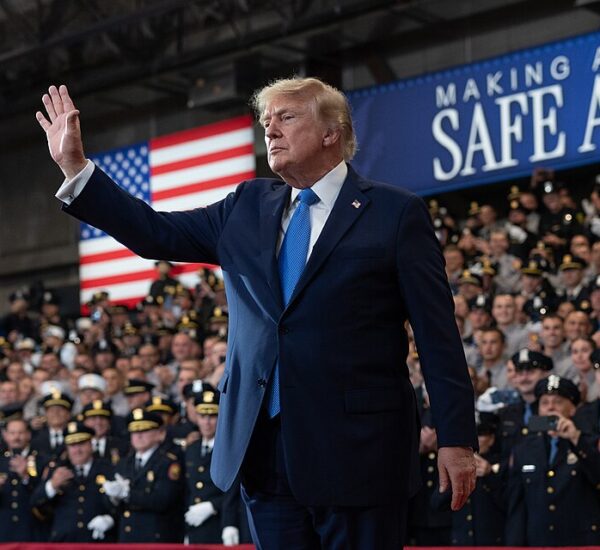
President Donald Trump just received unexpected support from a small European ally — and the move could have major implications for global security, NATO and growing tensions with Iran.
While many European leaders continue hesitating over military spending and international security responsibilities, the Czech Republic is taking a dramatically different approach.
In a striking show of support for the Trump administration, Czech Foreign Minister Petr Macinka announced that his country is prepared to help protect one of the world’s most important shipping routes: the Strait of Hormuz.
The narrow waterway is one of the most critical oil transit routes on Earth, carrying nearly one-fifth of the world’s oil supply. Any disruption there could send energy prices soaring worldwide and create serious economic consequences for American families and businesses.
Speaking during meetings at the United Nations in New York, Macinka revealed that Prague has already discussed ways it could assist allied efforts aimed at protecting freedom of navigation amid escalating threats from Iran.
“We are ready to help defend free passage through Hormuz,” Macinka said.
Although the Czech Republic is a landlocked nation without a navy, Macinka explained that his country possesses specialized passive surveillance technology capable of assisting military and intelligence operations.
The announcement comes at a time when the Trump administration has been pressuring NATO allies to step up and shoulder more responsibility instead of relying overwhelmingly on the United States military.
For years, President Trump has argued that America has carried too much of the burden while wealthy European nations failed to invest adequately in their own defense.
Now, at least one European nation appears to be listening.
Macinka delivered an especially strong warning about Iran, describing the regime as a growing threat to global stability and international security.
According to the Czech foreign minister, Iran’s danger extends far beyond the Middle East through four key areas: nuclear weapons ambitions, ballistic missile and drone technology, international terrorism and threats against critical shipping lanes.
“The Iranian nuclear program must be stopped,” Macinka warned. “This is a global threat.”
The comments closely align with the Trump administration’s increasingly aggressive stance toward Tehran as concerns continue growing over regional instability and attacks tied to Iranian-backed forces.
Secretary of State Marco Rubio recently questioned whether the United States should continue maintaining military bases in allied nations that later restrict American military operations during times of conflict.
Rubio suggested that if allies benefit from American protection, they should also stand firmly beside the United States when security threats emerge.
President Trump has echoed those frustrations repeatedly, criticizing NATO members that refuse to fully commit resources or military support during international crises.
Earlier this year, Trump reportedly warned that NATO risks becoming ineffective if member nations continue depending almost entirely on American taxpayers while avoiding difficult military responsibilities themselves.
The Czech Republic, however, appears eager to move in the opposite direction.
A NATO member since 1999, Prague has already reached NATO’s defense spending benchmark of 2% of GDP — something many larger European countries still have not achieved.
Macinka openly defended Trump’s push for stronger European defense spending and greater military readiness across the continent.
“Europe waited too long to strengthen its defenses,” he said.
The Czech leader also criticized the European Union’s costly climate agenda, arguing that massive green energy spending has weakened Europe’s ability to properly fund national defense.
“If Europe abandons this climate alarmism, there will be enough money to strengthen our military capabilities,” Macinka argued.
His comments are likely to resonate with conservatives across both Europe and the United States who believe progressive climate policies have drained resources away from national priorities like defense, energy independence and border security.
Macinka also voiced direct support for President Trump and what he described as a worldwide return to “common sense” leadership.
“We are friends of America and friends of Israel,” he said. “I support the direction of the current American administration.”
That type of public praise from a European foreign minister is becoming increasingly rare and highlights the growing divide inside Europe over nationalism, defense policy and relations with Washington.
At the same time, the Czech Republic continues strongly backing Ukraine in its war against Russia.
Macinka said his nation’s painful history under Soviet occupation still shapes Czech public opinion today. Following the Soviet-led invasion of Czechoslovakia in 1968, the country spent decades living under communist domination.
Because of that history, many Czech citizens strongly sympathize with Ukraine’s struggle against Russian aggression.
“The Czech people feel deep solidarity with Ukraine,” Macinka explained.
The Czech Republic has also played a leading role in supplying artillery ammunition to Ukraine through an international donor initiative. According to Macinka, the program delivered more than 500,000 artillery rounds during 2026 alone.
Still, the Czech foreign minister acknowledged that America’s growing focus on the Middle East could eventually force Europe to take on a larger role in future Ukraine negotiations.
“America is very busy in the Middle East right now,” he said. “Europe must wake up and earn its place at the negotiating table.”
As global tensions continue rising, the Czech Republic’s strong support for President Trump’s security priorities may signal that at least some European allies are finally beginning to take America’s warnings seriously.