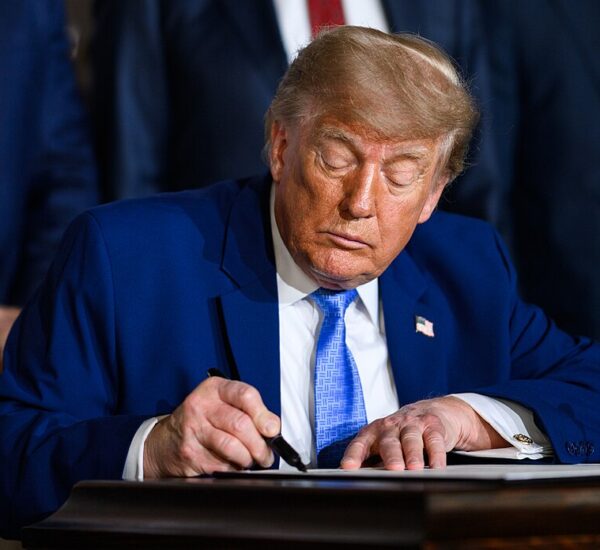
The Trump administration is moving to tighten oversight of financial institutions that provide loans to people living in the U.S. illegally. A group of federal banking regulators is expected to issue guidance reminding banks to consider immigration status-related risks when evaluating borrowers, including concerns about repayment ability if a borrower faces deportation or loses work authorization.
BACKGROUND
The new guidance follows President Donald Trump’s May executive order directing agencies and financial regulators to examine how people without legal status interact with the U.S. financial system. The Office of the Comptroller of the Currency, the Federal Deposit Insurance Corporation, and the National Credit Union Association are involved in the planned announcement. Earlier measures from the Treasury’s financial crimes division advised banks to watch for potential issues involving identity theft, payroll tax fraud, and money laundering connected to unauthorized employment. Officials said the guidance is intended to encourage financial institutions to use risk-based lending practices rather than directly requiring banks to stop serving specific customers.
Trump Informs Congress Of Restart Of Iran War
President Donald Trump has officially notified Congress that the United States has resumed military operations against Iran, marking a significant escalation in tensions between the two nations. The move also starts a new timeline under the War Powers Act, allowing U.S. forces to continue military operations in the region for up to 60 days without additional approval from Congress.
The formal notification comes as the United States increases pressure on Tehran and expands efforts to protect one of the world’s most important energy corridors, the Strait of Hormuz.
Trump Informs Congress of Military Action
In a two-page letter sent to lawmakers on Friday, Trump confirmed that U.S. military strikes against Iranian targets resumed on July 7, complying with the War Powers Act requirement that Congress be notified within 48 hours of military action overseas.
The president emphasized that the operation is carefully planned and designed to achieve military objectives while limiting civilian casualties.
Trump said no American ground troops were taking part in the operation, adding that the strikes were narrowly targeted, carefully coordinated, and carried out with precautions intended to reduce civilian harm.
The administration also stressed that no American ground troops are participating in the operation, with the campaign relying on precision military capabilities.
What the War Powers Act Means
Under the War Powers Act, a president may continue military operations for 60 days after notifying Congress. If necessary, that authority can be extended for an additional 30 days.
Any military action lasting beyond that period generally requires authorization from Congress.
Earlier this year, Trump argued that a temporary ceasefire with Iran effectively paused the original War Powers timeline. In a previous letter to lawmakers, he maintained that the ceasefire halted the countdown after hostilities first erupted in late February.
With military operations now underway again, the administration has started a new notification period under federal law.
Strait of Hormuz Becomes Center of Conflict
The latest military action comes as tensions continue to rise over control of the Strait of Hormuz, one of the world’s most strategically important waterways.
Roughly 20 percent of global oil and natural gas shipments pass through the narrow passage, making it critical to international trade and global energy markets.
Any disruption to shipping through the Strait has the potential to affect fuel prices, supply chains, and economies around the world.
Trump Announces New Naval Blockade
On Monday, Trump announced that the United States would reinstate its naval blockade in the Strait of Hormuz beginning Tuesday afternoon.
The president also said the United States should be compensated for providing security in the region, arguing that protecting one of the world’s busiest shipping lanes comes at a significant cost.
Writing on Truth Social, Trump declared that America would be known as “THE GUARDIAN OF THE HORMUZ STRAIT.” He also proposed that the United States receive reimbursement equal to 20 percent of all cargo transported through the waterway to help cover the costs of maintaining security.
The proposal reflects the administration’s effort to increase pressure on Iran while emphasizing America’s role in protecting international commerce.
U.S. Military Expands Air Campaign
According to U.S. Central Command (CENTCOM), American forces launched four separate waves of strikes against Iranian targets during the past week.
Military officials said the operations were carried out after Iran allegedly targeted commercial vessels attempting to transit the Strait of Hormuz.
CENTCOM reported that more than 300 military targets inside Iran have been struck, with the latest round of attacks taking place on Sunday.
Officials say the campaign is intended to protect commercial shipping, preserve freedom of navigation, and defend American interests in the region.
Trump Signals Tougher Approach
Speaking during the recent NATO summit, Trump suggested that any previous ceasefire with Iran is no longer in effect, signaling a more aggressive U.S. posture moving forward.
In his letter to Congress, the president defended the military action as necessary to protect Americans and advance U.S. national security interests.
Trump said he ordered the military operation as part of his constitutional duty to defend the American people, safeguard U.S. interests at home and overseas, and advance the nation’s national security and foreign policy objectives.
The administration maintains that the operation is aimed at deterring future attacks while protecting U.S. personnel, allies, and international shipping routes.
Why This Matters
The renewed conflict between the United States and Iran could have far-reaching consequences beyond the Middle East.
Because the Strait of Hormuz serves as one of the world’s busiest energy corridors, any prolonged military confrontation could influence global oil prices, shipping costs, financial markets, and inflation.
The situation is also being closely watched by America’s allies, energy producers, and businesses that rely on stable international trade routes.
Frequently Asked Questions
Why did Trump notify Congress?
Federal law requires the president to notify Congress within 48 hours after military operations begin overseas under the War Powers Act.
How long can military operations continue without congressional approval?
The War Powers Act allows military operations to continue for 60 days, with a possible 30-day extension if necessary before additional congressional authorization is generally required.
Why is the Strait of Hormuz so important?
Approximately 20 percent of the world’s oil and natural gas shipments move through the Strait of Hormuz, making it one of the most strategically important waterways for global energy supplies and international commerce.
What Comes Next?
With Congress now formally notified and military operations continuing, attention will shift to Iran’s response, the administration’s next strategic decisions, and whether lawmakers will seek a greater role if the conflict continues beyond the timeline allowed under the War Powers Act.
As tensions remain high in the Middle East, developments over the coming weeks could shape U.S. foreign policy, global energy markets, and international security for months to come.