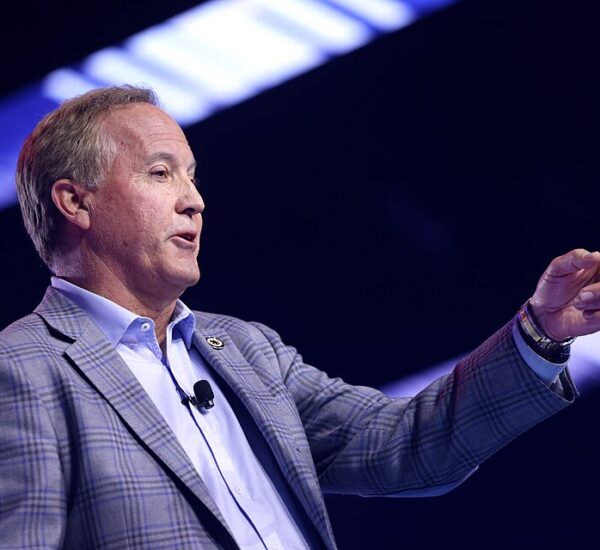
Here’s what President Trump decided to do.
President Donald Trump delivered a major trade announcement during his trip to Ireland on Sunday, declaring that the United States will remove the 10% tariff currently imposed on Irish whiskey.
The announcement came during the closing ceremony of the Irish Open at Trump International Golf Links in Doonbeg, Ireland, where Trump appeared before a large crowd following the conclusion of the tournament.
Trump said he had been hearing repeated requests to eliminate the tariff and ultimately decided to move forward.
“Everybody’s been bugging me,” Trump told the crowd as he described the appeals he had received over the issue.
Trump then announced that, on behalf of the United States, he intended to take the tariff off Irish whiskey.
The response was immediate.
Spectators erupted in applause, with some members of the crowd chanting “U-S-A” following the president’s announcement.
For Irish whiskey producers — and American businesses that import and sell their products — the decision could have meaningful economic consequences.
Trump Targets 10% Irish Whiskey Tariff
Irish whiskey currently faces a 10% U.S. tariff as part of broader duties affecting European imports.
The American market is particularly important to Ireland’s whiskey industry, which has pushed for the removal of the trade barrier.
Trump’s announcement followed requests from several prominent figures, including Irish Prime Minister Micheál Martin and Irish Open champion Shane Lowry.
The Distilled Spirits Council of the United States also welcomed the development, arguing that removing the tariff could benefit American restaurants, bars, retailers, distributors and consumers.
The announcement represents a notable change for an administration that has made tariffs a major part of its economic and trade agenda.
Trump has repeatedly argued that tariffs can protect American interests and provide leverage when negotiating with foreign governments. At the same time, his administration has shown a willingness to modify individual duties when officials believe different trade arrangements make sense.
In this case, Irish whiskey appears headed for an exemption.
A precise date for when the tariff will officially disappear was not immediately announced.
Shane Lowry Delivers Historic Irish Open Victory
Trade wasn’t the only major story coming out of Doonbeg.
Irish golfer Shane Lowry delivered a dominant performance at the Irish Open, winning the tournament by a record 11 shots.
Lowry finished at 23-under 257 after shooting a final-round 63, giving the home crowd another reason to celebrate.
The victory was Lowry’s second Irish Open title. His first came 17 years earlier when he captured the championship as an amateur.
Trump presented Lowry with the championship trophy following the tournament.
The president also revealed that he had made a late decision to remain in Ireland so he could watch Lowry finish his run toward victory.
Lowry ultimately rewarded the crowd with one of the most commanding performances in the tournament’s history.
Why Removing the Tariff Matters
While a tariff on Irish whiskey may appear to be a relatively narrow trade issue, its removal could affect businesses on both sides of the Atlantic.
Tariffs are taxes charged on imported goods. Although they are collected from importers, the additional costs can work their way through the supply chain and affect distributors, retailers, restaurants and ultimately consumers.
Removing a tariff can therefore lower the cost of bringing a foreign product into the United States, although there is no guarantee that the entire savings will be reflected in retail prices.
The U.S. spirits industry has also argued that eliminating the Irish whiskey tariff could help American hospitality businesses that sell imported spirits.
For Ireland, access to the American market is particularly important because Irish whiskey has developed a significant following among U.S. consumers.
That helps explain why the tariff became an issue during Trump’s visit.
Trump Also Weighs In on Irish Unification
Trump’s trip generated attention beyond trade and golf.
During his visit, the president publicly expressed support for the possibility of eventually unifying Northern Ireland with the Republic of Ireland.
Ireland was partitioned more than a century ago. Most of the island eventually became what is now the Republic of Ireland, while Northern Ireland remained part of the United Kingdom.
The question of reunification remains politically sensitive because of the island’s history and the decades of sectarian violence known as the Troubles.
The 1998 Good Friday Agreement established a framework under which Northern Ireland could become part of a united Ireland if voters supported such a change through the democratic process.
Trump said he would like to see Ireland unified, while acknowledging that the United Kingdom would have a major role in the matter.
The British government responded by reiterating its position that another referendum would depend on evidence that public support for reunification had reached the necessary level.
Irish Prime Minister Micheál Martin has also emphasized the importance of approaching the issue through the framework established by the Good Friday Agreement.
Trump’s Ireland Visit Mixes Trade, Diplomacy and Golf
Trump’s trip ultimately brought together several subjects that rarely share the same stage: international trade, Irish politics and professional golf.
But the tariff announcement could have the most immediate economic consequences.
Irish whiskey producers have sought relief from U.S. duties, while American businesses involved in importing, distributing and selling the product could also benefit from eliminating the additional cost.
Trump has now publicly committed to removing the 10% tariff.
The remaining question is how quickly the administration formally puts that decision into effect.
For the crowd gathered in Doonbeg on Sunday, however, Trump’s announcement was enough to trigger an unmistakably enthusiastic reaction.
Cheers erupted across the golf course — followed by chants of “U-S-A.”