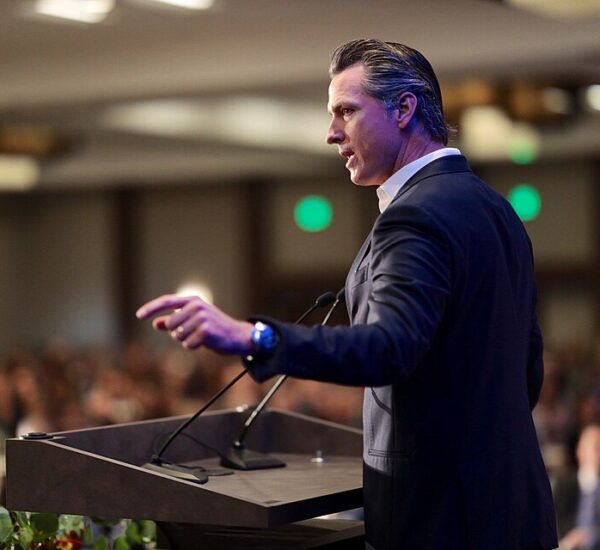
America is fed up with Newsom.
A new statewide poll indicates that Governor Gavin Newsom’s proposal to phase out sales of new gas-powered vehicles in California is losing public support, with many voters expressing opposition to one of his most prominent climate policies.
The latest survey from the nonpartisan Public Policy Institute of California found that nearly two-thirds of likely voters oppose the state’s 2035 requirement that all new passenger vehicles sold be zero-emission models.
Among likely voters, 65% oppose the mandate, while 34% support it, highlighting a major shift in public opinion since the proposal was first introduced.
California Voters Turn Against Gas Car Ban
The new polling suggests Californians have become increasingly skeptical of the state’s aggressive push toward electric vehicles.
When the proposal was first debated in 2021, voters were almost evenly divided. Today, opposition has grown substantially as inflation, rising energy costs, and overall affordability continue to dominate household budgets.
The survey also found stronger resistance among infrequent voters, indicating concerns extend well beyond one political group.
Support Weakens Even Among Democrats
While Republican voters remain overwhelmingly opposed to the mandate, the poll shows support has also softened among Democrats.
Democratic backing has fallen to nearly an even split, a notable change from previous surveys that showed a clearer majority supporting the policy.
The numbers suggest affordability concerns are beginning to outweigh political loyalty for many California voters.
Why Many Californians Are Concerned
Newsom signed the executive order in 2020, arguing that ending sales of new gasoline-powered passenger vehicles by 2035 would help reduce greenhouse gas emissions and move California toward its long-term climate goals.
However, many residents remain focused on the practical realities of making the transition.
Electric vehicles often cost more than comparable gas-powered models, even after incentives. Many drivers also worry about charging availability, longer charging times, battery range, and the convenience of taking longer road trips.
For families already dealing with higher living expenses, purchasing a new electric vehicle can represent a significant financial commitment.
Rising Living Costs Drive the Debate
Public Policy Institute of California Polling Director Mark Baldassare said Californians continue to care deeply about environmental issues, but economic pressures are becoming increasingly difficult to ignore.
According to Baldassare, concerns about electricity prices, household budgets, and the overall cost of living are playing a larger role in how voters view state climate policies.
Those affordability concerns are now influencing California’s political landscape as much as environmental priorities.
California Expands Electric Vehicle Incentives
Despite growing public opposition, California lawmakers recently approved $135 million in new incentives designed to encourage more residents to purchase electric vehicles.
The program provides rebates of up to $3,500 for qualifying first-time buyers purchasing new electric vehicles priced at $50,000 or less. Eligible buyers of used EVs may receive rebates of up to $1,750.
Automakers are expected to pay for roughly half of the program’s cost, although some analysts have questioned whether those expenses could eventually be reflected in higher vehicle prices.
The state incentives also come after the previous federal tax credit of up to $7,500 for qualifying new electric vehicles expired last year.
Charging Infrastructure Remains a Major Concern
California continues to lead the nation in electric vehicle ownership, with approximately 1.3 million registered EVs.
Even so, the survey found many residents remain unconvinced that the state’s charging infrastructure is prepared for a complete transition away from gasoline-powered vehicles.
Respondents were about twice as likely to express concern that California will not build enough charging stations as they were to say they are confident the state will be ready.
The California Energy Commission reports there are now more than 200,000 public and shared private charging stations, along with roughly 800,000 home chargers, with additional projects planned across the state.
Californians Still Support Broader Climate Goals
While opposition to the gas-powered vehicle mandate has increased, the poll found that many Californians continue to support broader environmental initiatives.
Strong majorities continue to back California’s goal of achieving net-zero greenhouse gas emissions by 2045, expanding renewable energy production, and requiring businesses to reduce carbon emissions.
The findings suggest many voters are distinguishing between supporting long-term environmental goals and supporting government mandates that could significantly affect the cost of purchasing a new vehicle.
Bottom Line
The latest polling signals that Governor Gavin Newsom’s 2035 gas-powered vehicle mandate is becoming one of California’s most debated policies. While many residents continue to support efforts to reduce emissions, growing concerns over affordability, energy costs, and charging infrastructure appear to be reshaping public opinion.
As California moves closer to the 2035 deadline, the debate over electric vehicles, consumer costs, and state climate policy is likely to remain at the center of political discussion.